Short answer: Over long stretches, home values in the Madison area have grown faster than inflation, partly because inflation raises the cost of building new homes. But it is not automatic. Inflation also tends to push mortgage rates up, and there have been years when local home values fell while everyday prices kept rising.
Here is how that works, in plain terms.
What inflation is, in plain words
Inflation means the same dollar buys less than it used to. The government tracks it with the Consumer Price Index, or CPI, which follows the price of things like food, gas, rent, and cars.
In September 2026, the CPI was up 3.7% from a year earlier, according to the Bureau of Labor Statistics.
Energy was a big reason. Gasoline prices were up 34.2% over the year.
Shelter costs were up 3.2%, and rent was up 2.8%.
So the question for a homeowner is simple: when a dollar is worth less, is my house worth more dollars?
Why home prices tend to rise with inflation
A house is a real thing made of lumber, concrete, wire, and labor. When those costs go up, the price of a new home goes up too. And when new homes cost more, existing homes nearby look like a better deal, so their prices tend to follow.
Building costs have been climbing. In a July 2026 survey, builders told the National Association of Home Builders that material costs for the same house were up a median of 6.7% from a year earlier.
That is the basic economics: if it costs more to replace something, the ones that already exist usually become more valuable. Add Dane County's tight supply, and that pressure is stronger here than in many places.
What the Madison numbers show
The Federal Housing Finance Agency (FHFA) tracks home values in the Madison metro area by following repeat sales of the same homes. Comparing it with the CPI from the second quarter of each year:
Last 20 years (2006 to 2026): Madison area home values rose about 109%. Consumer prices rose about 65%.
Last 10 years (2016 to 2026): Home values rose about 97%. Consumer prices rose about 39%.
2008 to 2012: Home values fell 6.7%, while consumer prices rose 7.1%.
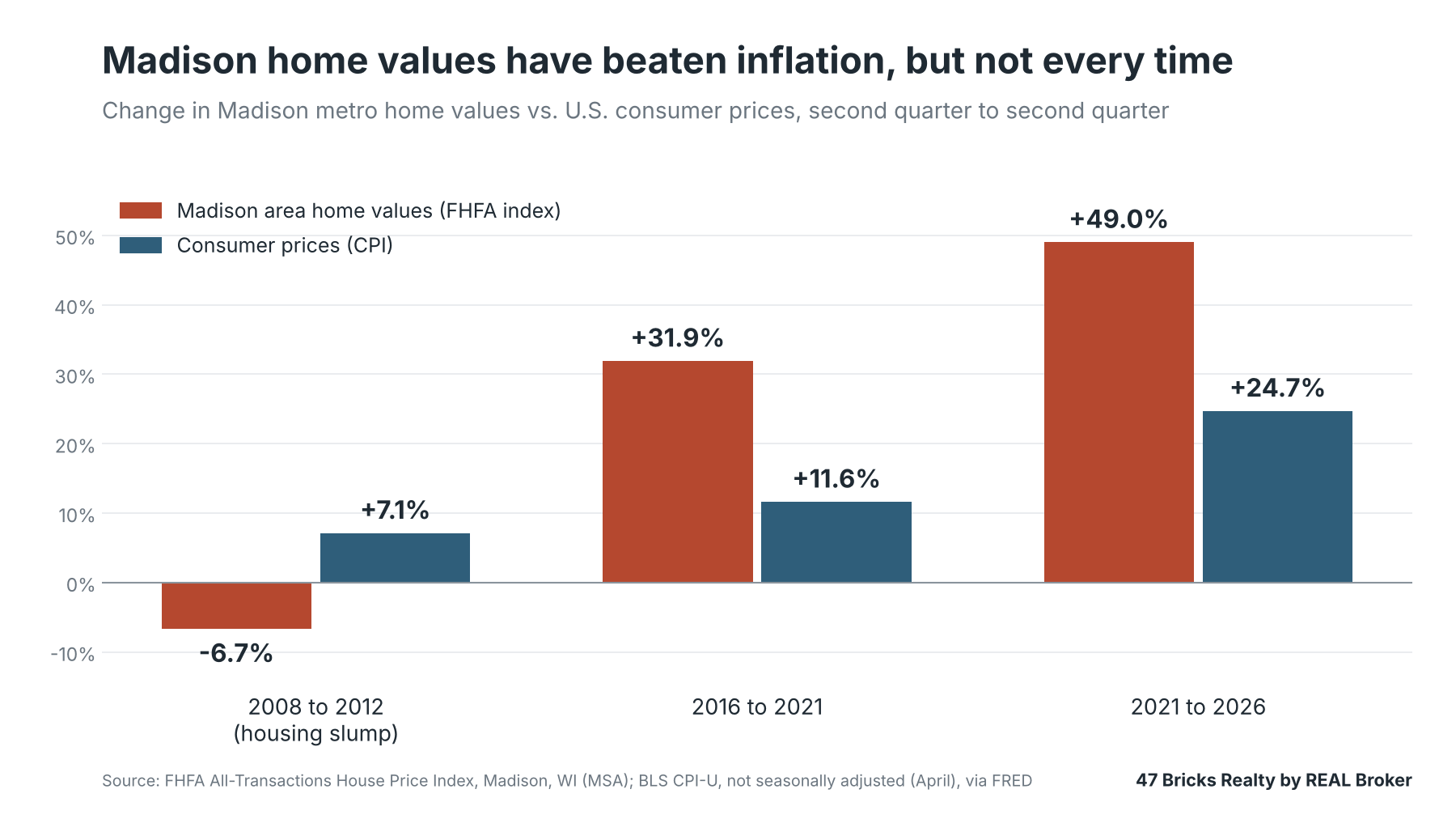
That last line matters. During the housing slump, Madison homeowners lost ground to inflation for several years. A home has protected buying power over the long run, but not in every short stretch.
Wisconsin as a whole has also been mixed lately. The statewide median price in September 2026 was $342,000, up 1.5% from a year earlier, according to the Wisconsin REALTORS Association. That is less than the 3.7% inflation rate. In the Madison area, the September median single-family price was $508,950, up 6% from $480,000, based on South Central Wisconsin MLS data.
The fixed-rate mortgage advantage
Here is a part of the story many people miss. If you have a fixed-rate mortgage, your principal and interest payment does not change for the life of the loan, no matter what happens to prices.
Over time, inflation tends to push up wages and rents.
Your loan payment stays the same in dollars.
So each year, that payment takes up a smaller share of a typical paycheck, and you pay back the loan with dollars that are worth less.
Renters do not get that benefit. Their housing cost can reset every lease. Note that property taxes and insurance can still rise, so your total monthly payment is not fully frozen.
The catch: inflation often brings higher rates
Inflation does not only push prices up. It also pushes borrowing costs up. Lenders do not want to be paid back in dollars that keep losing value, so they charge more.
The average 30-year fixed mortgage rate was 7.32% for the week of October 22, 2026, according to Freddie Mac. Higher rates shrink how much a buyer can borrow, and that can slow price growth even while other costs rise. That tug of war is one reason home prices and inflation do not move in lockstep.
What would have to happen for homes to lose ground to inflation?
I don't make price predictions. But here is what would have to happen for Madison area home values to fall behind inflation for a long stretch:
Rates stay high while inflation stays high. If borrowing stays expensive for years, buyers can only stretch so far.
A big jump in homes for sale. The Madison area had about 2.1 months of single-family supply in early October. A balanced market is usually 4 to 6 months.
A real hit to local jobs. Fewer paychecks means fewer buyers, no matter what building costs do.
What this means for you
If you own: Your home has been a solid way to keep up with rising prices over time, especially with a fixed-rate loan. Just don't count on it beating inflation every single year.
If you're buying: Inflation can work in your favor once your payment is locked in. Focus on a payment you can handle today, including taxes and insurance.
If you're selling: Higher building costs help support what existing homes are worth. Price for today's buyers, who are watching rates closely.
Have a question about your own situation? Call or text me at 608.213.3654.
Sources
U.S. Bureau of Labor Statistics, Consumer Price Index news release, September 2026 (October 14, 2026)
Federal Reserve Bank of St. Louis (FRED), Consumer Price Index for All Urban Consumers: All Items in U.S. City Average (CPIAUCNS)
Federal Reserve Bank of St. Louis (FRED), All-Transactions House Price Index for Madison, WI (MSA), U.S. Federal Housing Finance Agency data
National Association of Home Builders, Eye On Housing, Cost of Materials Rises, Especially for Smaller Builders (August 24, 2026)
FOX 11 News, Wisconsin REALTORS Association September 2026 report (October 22, 2026)
Mad City Dream Homes, Madison Area Single Family Home Trends for September, 2026 (South Central Wisconsin MLS data)
Freddie Mac, Primary Mortgage Market Survey (week of October 22, 2026), via Mortgage News Daily