Short answer: For about a decade, the Madison area added jobs much faster than it added homes. Building has picked up since 2020, but most of the new homes are apartments, and it takes years to close a gap that big. So homes for sale are still scarce.
Here is how that works, in plain terms.
Jobs bring people, and people need homes
Housing demand starts with jobs. When an area adds jobs, people move in to fill them. Roommates split up, and grown kids move into places of their own. Each of those steps creates a new household, and each household needs a place to live.
The Madison area has a strong job base. According to a 2025 HUD market report, the largest employers include:
UW-Madison, about 27,300 workers
UW Health, about 18,000
The State of Wisconsin, about 11,500
Epic Systems, about 11,000
Those are steady employers. Steady jobs mean steady demand for homes, year after year.
The 2010s: jobs ran ahead of homes
Federal data tells the story. In the Madison metro area (Dane, Columbia, Green and Iowa counties):
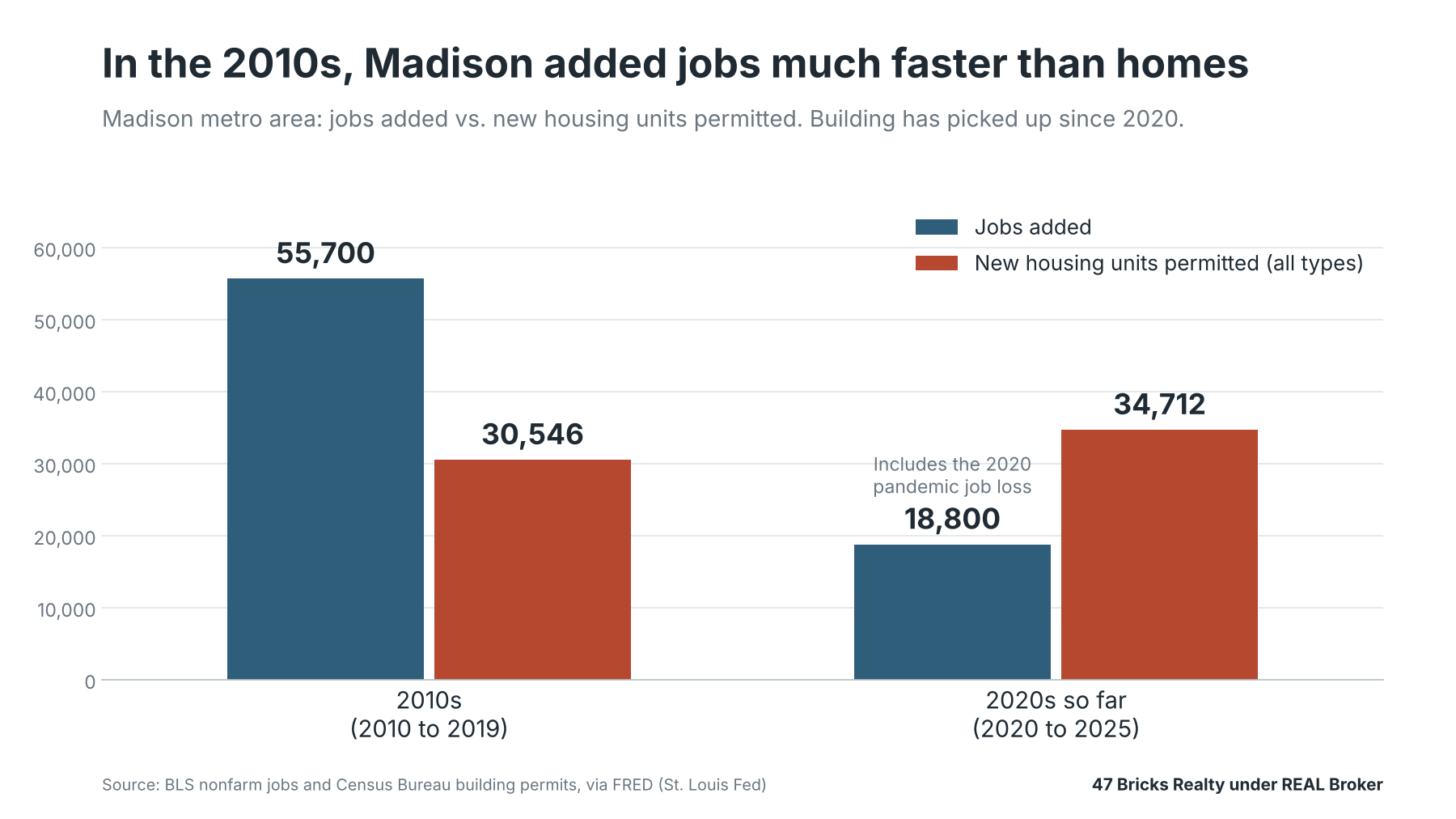
The area added about 55,700 jobs from 2009 to 2019, according to the Bureau of Labor Statistics.
Over the 2010 to 2019 building years, it permitted only 30,546 new housing units of all types, according to the Census Bureau.
That is close to 2 new jobs for every new home. Not every new job needs a new home. Some go to people who already live here, and many households have two workers. But a gap that wide, year after year, adds up.
Other studies found the same thing. A 2019 Wisconsin REALTORS Association report found Dane County underbuilt by more than 11,000 units from 2006 to 2017.
Building has picked up, but mostly apartments
Since 2020, the picture has changed. From 2020 through 2025, the metro area permitted 34,712 new housing units, more than it did in the whole 2010s. Job growth slowed, partly because of the 2020 pandemic job loss of 21,700 jobs.
So why does it still feel so tight? Because of what is being built.
From 2021 to 2023, the area permitted about 5,100 rental units a year, according to HUD.
In 2022 and 2023, it permitted only about 1,625 for-sale homes a year (houses, townhomes and condos).
Apartments help renters, and they are making a difference: HUD put the rental vacancy rate at 6.0% in 2025. But for buyers, the picture is very different. The vacancy rate for homes for sale was just 0.6%. HUD called the sales market "tight."
Households are also forming faster. HUD says the area added about 4,750 households a year since 2020, up from about 3,675 a year in the 2010s.
Why builders can't just catch up
In most markets, a shortage pushes prices up, and higher prices pull in more building. That is supply and demand. With housing, the second half is slow.
Land and approvals take time. A new neighborhood can take years to go from farm field to finished homes.
Costs are high. Land, labor, materials and borrowing all cost more. That pushes builders toward projects that pencil out, which are often apartments or higher-priced homes.
The target keeps moving. Dane County's housing plan calls for at least 7,000 new units a year. In 2024, the county permitted 5,477.
When homes can't keep up, people find them farther away. About 9,800 people commute from Rock County into Dane County for work, while about 3,100 go the other way, according to 2022 Census data reported by the Badger Institute.
What would it take to close the gap?
I don't make predictions. But here is what would have to happen for housing to catch up with jobs here:
Several years of building more homes than new households need. The recent pace is better, but it has not been sustained long enough to make up for the 2010s.
More for-sale homes in the mix. More townhomes, condos and smaller single-family homes would help buyers most.
Slower job growth. Job growth has cooled lately. If that lasts while building stays strong, the gap would shrink. That is not the kind of fix most people hope for.
What this means for you
If you're buying: The shortage is long-term, not a blip. Waiting for it to fix itself could take years. Get your budget and financing ready so you can act when the right home shows up.
If you're selling: Steady local jobs keep demand steady. Buyers still compare, so price it right and show it well.
If you're open to a new build or a nearby town: Widening your search can give you more choices. Compare the commute, the taxes and the total cost, not just the price.
Have a question about your own situation? Call or text me at 608.213.3654.
Sources
U.S. Bureau of Labor Statistics, All Employees: Total Nonfarm in Madison, WI (MSA), via FRED, Federal Reserve Bank of St. Louis
U.S. Census Bureau, New Private Housing Units Authorized by Building Permits for Madison, WI (MSA), via FRED, Federal Reserve Bank of St. Louis
U.S. Department of Housing and Urban Development, Comprehensive Housing Market Analysis: Madison, Wisconsin (as of May 1, 2025)
Greater Madison Chamber of Commerce, Metro Metrics January 2026 (Dane County Regional Housing Strategy 2024 metrics; Wisconsin REALTORS Association 2019 report)
Badger Institute, Commuter traffic flows both ways in Wisconsin metro areas