
Short answer: Home prices fall hardest when lots of owners lose their jobs and have to sell at the same time. Madison's biggest employers, like the university, state government, and health care, tend to keep people working in a downturn. Fewer forced sales means prices hold up better, though not perfectly.
Here is how that works, in plain terms.
What really pushes prices down in a recession
A recession does not lower home prices by itself. Prices drop when there are more homes for sale than buyers. In a bad recession, that happens in two ways at once:
More sellers. People who lose a job may have to sell, sometimes fast and at a discount.
Fewer buyers. People who are worried about their job stop shopping for a home.
So the key question for any town is simple: how many people lose their jobs when the economy turns down? In the Madison area, the answer has been "fewer than most places."
Madison's job base is built on steady employers
A lot of Madison-area paychecks come from places that do not shut down when consumers stop spending.
The three largest employers in the Madison metro area are UW-Madison (about 27,300 workers), UW Health (about 18,000), and Epic Systems (about 11,000), according to a 2025 HUD market report.
In the three months ending May 2025, government jobs made up about 97,200 of the area's 429,000 jobs. That is more than 1 in 5.
Education and health services made up about another 13%.
Students still go to class in a recession. People still need doctors. State offices still open. That kind of job base bends in a downturn, but it does not usually break.
Fewer layoffs, fewer forced sales
You can see this in the unemployment numbers.
In the Great Recession, the Madison area's unemployment rate peaked at 7.2% in early 2010. The national rate peaked at 10.6% in January 2010.
In April 2020, at the start of the pandemic, Madison's rate jumped to 11.1%. The national rate hit 14.4%.
In August 2026, the Madison area was at 2.9%, compared with 4.3% for the country.
(These are not seasonally adjusted rates from the U.S. Bureau of Labor Statistics, reported on FRED.)
A lower jobless rate means fewer families who have to sell. That keeps the number of homes for sale from flooding the market.
What happened in the last housing crash
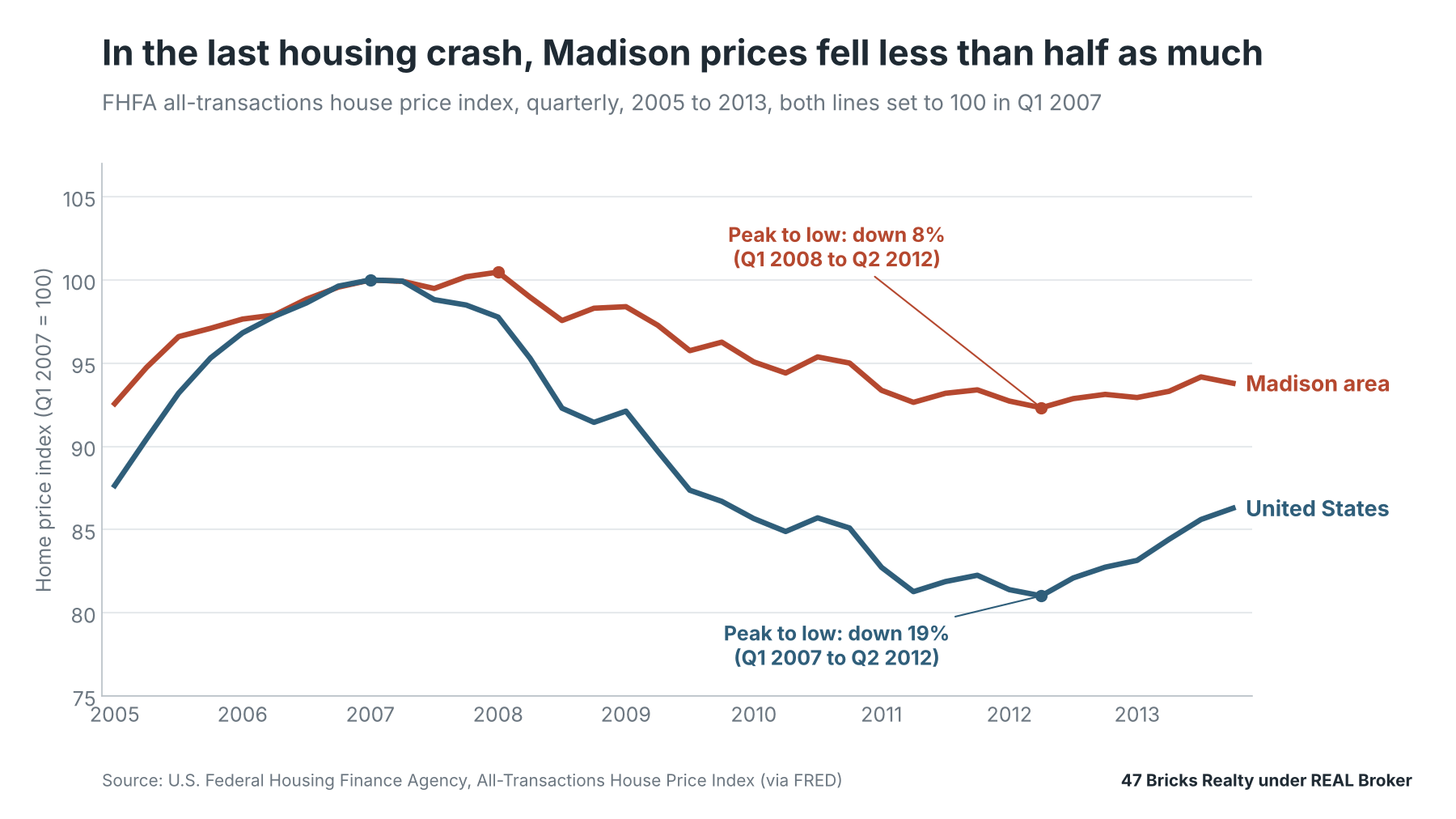
The 2008 crash is the best test we have. Here is what the federal home price index shows:
Across the U.S., home prices fell about 19% from their peak in early 2007 to their low in mid 2012.
In the Madison area, prices fell about 8% from their peak in early 2008 to their low in mid 2012.
So Madison prices still fell. But they fell less than half as much as the nation's. And the drop was slow and steady, not a sudden crash.
The pandemic was a different kind of shock. Even with a short spike in job losses, Dane County home prices rose about 3% in 2020 and about 9% in 2021, based on the same federal index.
Madison is not recession-proof
A steady economy is not a magic shield. In December 2009, the Cap Times ran a story called "The year Madison discovered it was no longer recession-proof."
The state ordered 16 unpaid furlough days to close a budget gap, which hit Madison's roughly 60,000 UW and government workers.
Dane County issued about 410 building permits through October 2009, compared with a 10-year average of about 2,000 a year.
Local companies cut jobs, and some building projects stalled.
The lesson: when the state budget gets squeezed, Madison feels it. A big public employer can protect jobs, but it can also cut pay or freeze hiring.
[TONY: add a quick note on what you saw buyers or sellers do during a past slowdown]
What would have to happen for prices to fall here?
I don't make price predictions. But here is what would have to happen for a recession to push Madison-area prices down in a meaningful way:
Deep cuts at the big employers. Large layoffs at the university, the state, health systems, or major tech employers would put more homes on the market.
A big jump in homes for sale. In May 2025, the area had about a 2.1-month supply of homes, and HUD called the market tight. It would take a lot of new listings to change that.
Buyers stepping back for a long time. If job worries kept buyers home for many months while listings piled up, prices could soften.
Without those, the more likely result of a recession here is slower sales and slower price growth, not a crash.
What this means for you
If you're buying: Don't plan on a recession bringing a big price drop in Dane County. Plan around your job security and the monthly payment you can carry.
If you're selling: In a slowdown, buyers get more careful. Pricing right from day one matters even more.
If you own and plan to stay: History suggests Madison-area values tend to hold up better than most. Focus on keeping your own finances steady.
Have a question about your own situation? Call or text me at 608.213.3654.
Sources
U.S. Federal Housing Finance Agency, All-Transactions House Price Index for Madison, WI (MSA), and for the United States (via FRED, Federal Reserve Bank of St. Louis)
U.S. Federal Housing Finance Agency, All-Transactions House Price Index for Dane County, WI (via FRED)
U.S. Bureau of Labor Statistics, Unemployment Rate in Madison, WI (MSA), not seasonally adjusted (via FRED)
U.S. Bureau of Labor Statistics, Unemployment Rate, not seasonally adjusted (via FRED)
U.S. Department of Housing and Urban Development, Madison, Wisconsin Housing Market Profile (June 2025)
Cap Times, The year Madison discovered it was no longer recession-proof (December 28, 2009)