
Short answer: Madison has a steady job base, a growing population, and not enough homes for everyone who wants one. When times get hard, fewer owners here are forced to sell, so prices dip less. That steadiness is why Madison held up much better than big Midwest metros like Chicago, Detroit, and Milwaukee in the last housing crash.
Here is how that works, in plain terms.
The best test: the last housing crash
The 2008 housing crash hit every part of the Midwest. But it did not hit every city the same way. Here is how much home prices changed from early 2007 to early 2012, based on the federal home price index:
Detroit: down 37.2%
Chicago: down 27.8%
Minneapolis-St. Paul: down 25.9%
Milwaukee: down 14.5%
Madison: down 7.3%
Madison still lost value. But a Madison owner lost about a quarter as much as a Chicago owner, and about half as much as a Milwaukee owner.
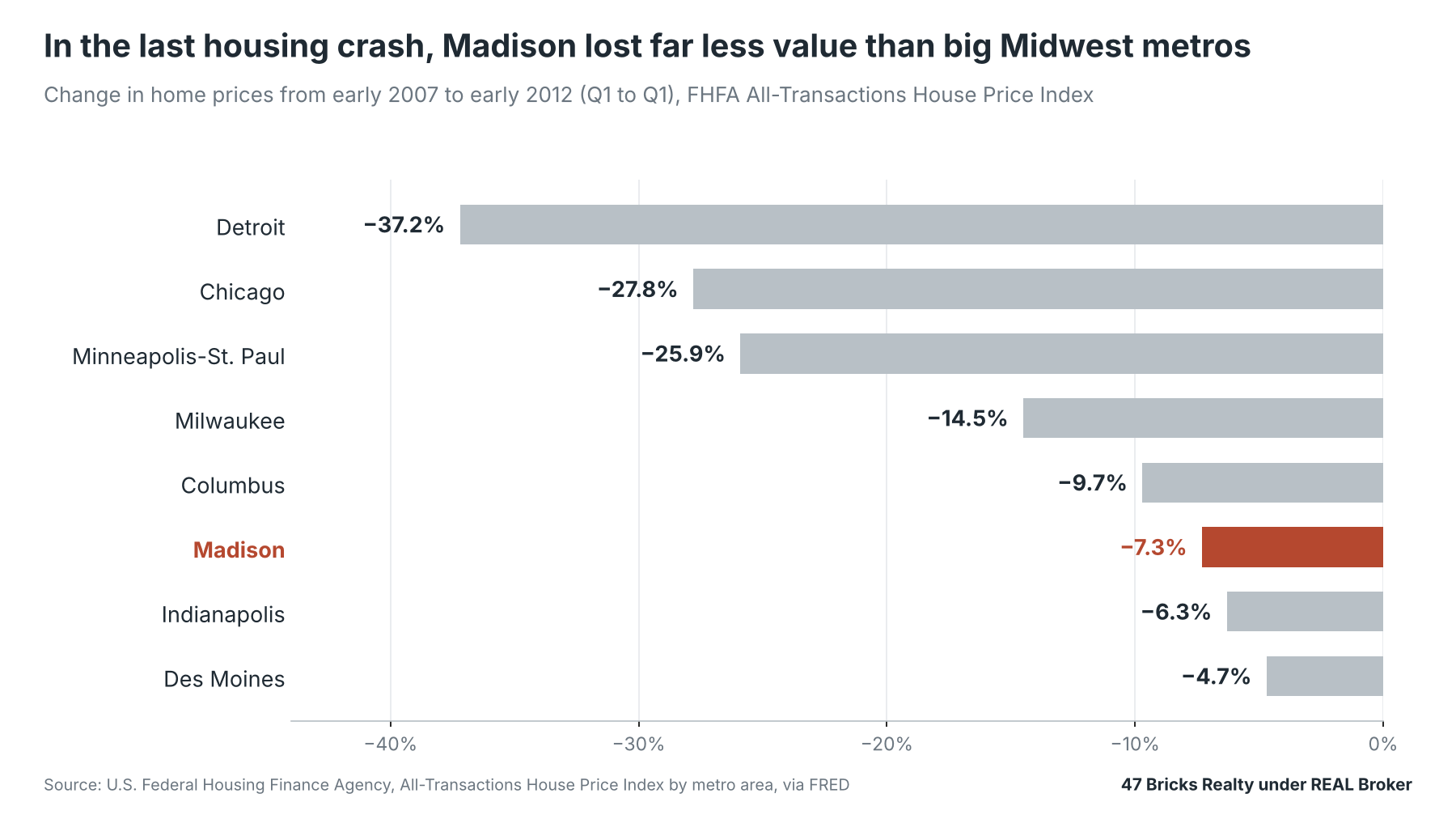
To be fair, Madison was not the only steady city. Des Moines (down 4.7%) and Indianapolis (down 6.3%) also held up well. The common thread is what drives demand in each place.
Reason 1: Jobs that don't vanish in a downturn
Home prices fall hardest when lots of owners lose jobs at the same time. Some have to sell. Others stop shopping. That pushes the market toward buyers.
Madison's biggest employers are things like the university, state government, and health care, plus a large tech employer in Epic. Students still go to class in a recession. People still need doctors. Those jobs can bend, but they don't usually disappear all at once.
Cities built more around one industry, like car making, can see a lot of people lose work at the same time. That is a big part of why Detroit's prices fell so far.
I covered how Madison's economy holds up in a recession in an earlier post.
Reason 2: More people keep moving in
Steady demand needs a steady stream of new households. Dane County has that.
Dane County grew from about 561,500 people in April 2020 to about 590,400 in July 2025, a 5.1% gain, according to the U.S. Census Bureau.
Over the same years, Wisconsin as a whole grew 1.3%, and the U.S. grew 3.1%.
Local planners in the Regional Data Group project Dane County could reach about 887,000 people by 2050.
Projections are not promises. But a county that keeps adding people keeps adding buyers, and that puts a floor under demand.
Reason 3: Higher incomes and more college degrees
Buyers can only pay what their paychecks support. In Dane County, those paychecks tend to be strong.
55.3% of adults 25 and older in Dane County have at least a bachelor's degree. The figure is 35.7% for the U.S. and 33.4% for Wisconsin.
Median household income in Dane County is about $89,975, compared with about $80,734 for the U.S. (Census figures, 2020 to 2024).
Jobs that need a degree tend to pay more and are often more stable. That gives more local families the ability to buy, even when prices are high.
Reason 4: Not enough homes to go around
The other half of the price equation is supply. Dane County has not built enough homes to keep up with its growth for years, a topic I covered in earlier posts.
The Regional Data Group estimates the county would need about 160,000 new housing units to keep up with its projected growth by 2050. That does not count catching up on past shortfalls.
When homes are scarce, a slowdown in buyers does not flood the market with unsold houses. That is a key reason prices here tend to level off instead of falling hard.
Steady is not the same as fastest
Here is something that may surprise you. Madison has not had the fastest price growth in the Midwest. From early 2007 to the spring of 2026, the federal index shows:
Columbus: up about 124%
Indianapolis: up about 119%
Madison: up about 104%
Milwaukee: up about 86%
Chicago: up about 44%
So Madison's real strength is steadiness. Prices here have tended to drop less in bad times and keep climbing in good times. That does not mean they can't fall. Here is what would have to happen for Madison to lose that edge:
Deep, lasting cuts at the university, state government, or the big health and tech employers.
Population growth stalling for years, so fewer new households need homes.
A long stretch of building more homes than the area needs.
[TONY: add a quick example of a buyer or seller moving here from another Midwest city, and what surprised them about Madison prices]
What this means for you
If you're buying: Don't expect Madison to swing the way bigger metros do. Plan around a monthly payment you can carry, not a hoped-for price drop.
If you're selling: Madison's steady demand works in your favor, but buyers still compare. Pricing right from day one matters.
If you're moving here from another Midwest city: Expect higher prices than you may be used to, along with a market that has a long track record of holding its value.
Have a question about your own situation? Call or text me at 608.213.3654.
Sources
U.S. Federal Housing Finance Agency, All-Transactions House Price Index for Madison, WI (MSA); Milwaukee-Waukesha, WI (MSA); Minneapolis-St. Paul-Bloomington, MN-WI (MSA); Chicago-Naperville-Evanston, IL (MSAD); Detroit-Dearborn-Livonia, MI (MSAD); Des Moines-West Des Moines, IA (MSA); Indianapolis-Carmel-Anderson, IN (MSA); Columbus, OH (MSA) (via FRED, Federal Reserve Bank of St. Louis)
U.S. Census Bureau, QuickFacts: Dane County, Wisconsin
U.S. Census Bureau, QuickFacts: Wisconsin
U.S. Census Bureau, QuickFacts: United States
Cap Times, New Dane County population projections see growth accelerating (December 18, 2025)