Short answer: In the first year, renting is usually cheaper in Madison, and by a wide margin. Over 10 years, owning often catches up, because rent keeps rising while a fixed mortgage payment does not, and owners build equity. But it is not a sure thing. It depends on how long you stay, what prices do, and what you would do with the money instead.
Here is how that works, in plain terms.
Month one: renting costs less
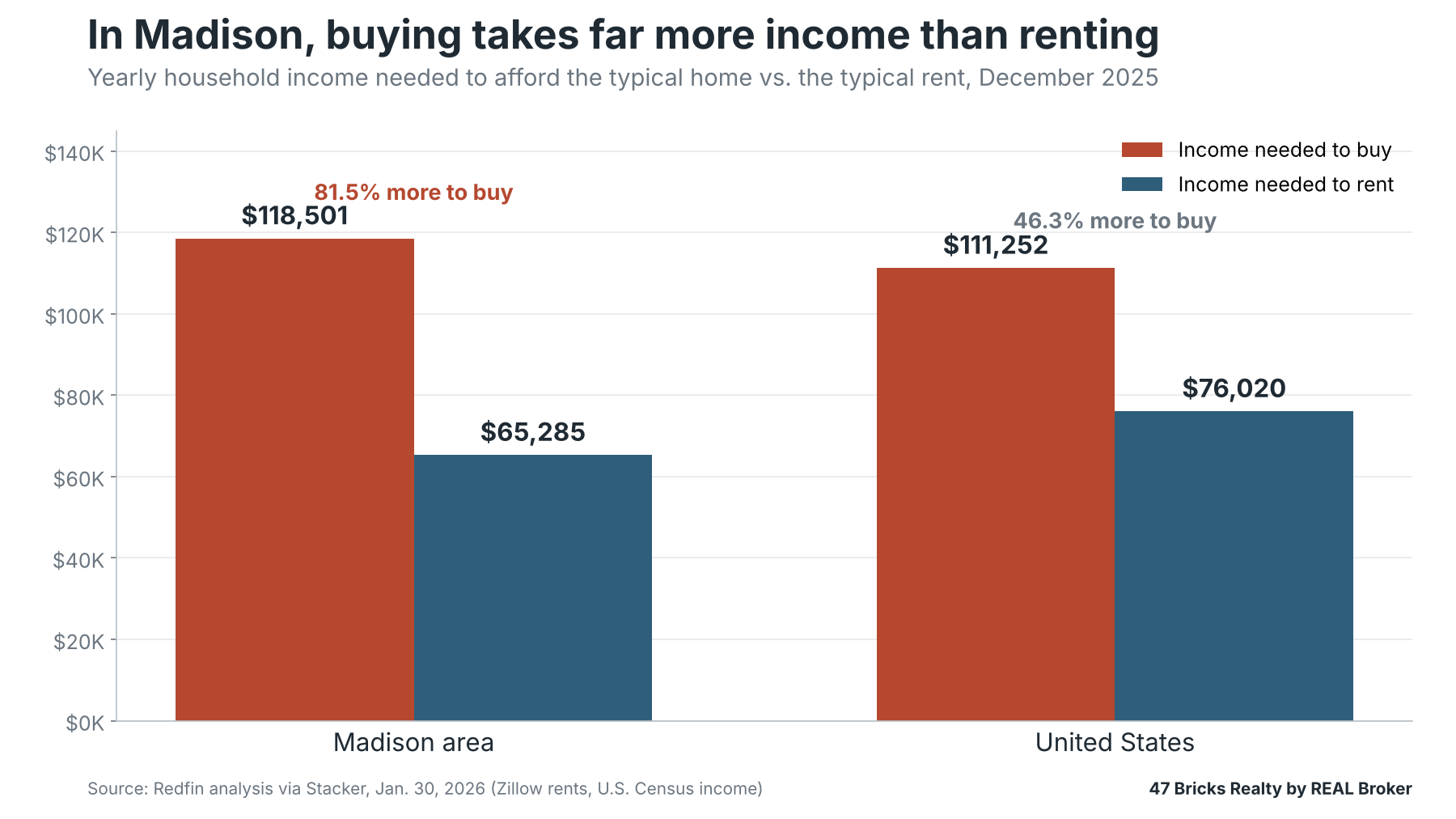
Right now, the gap between renting and buying in Madison is much bigger than it is nationally. A Redfin analysis of December 2025 data found:
The typical Madison home sold for $420,000. Typical rent was $1,632 a month.
A household needed about $118,501 a year in income to afford the typical home, but only about $65,285 to afford the typical rent.
That means buying took 81.5% more income than renting. Nationally, the gap was 46.3%.
Here is a simple example. Say you buy a $420,000 home with 20% down. At 7.11%, the Freddie Mac average 30-year rate on November 12, 2026, principal and interest come to about $2,260 a month. Property taxes and insurance come on top of that. These are round numbers to show the idea, not a loan quote.
So in year one, the renter usually spends less each month.
Rent goes up. A fixed payment does not.
This is where the 10-year view changes things. With a fixed-rate mortgage, your principal and interest stay the same for the life of the loan. Rent does not stay the same.
In the City of Madison, median monthly rent rose from $939 in 2015 to $1,364 in 2023, up 45%, according to the city's 2025 Housing Snapshot.
Nationally, the rent part of the Consumer Price Index rose about 50% from October 2016 to October 2026.
Property taxes, insurance and repairs still go up for owners. But the biggest part of the payment is locked in. Over time, the gap between a rising rent and a steady mortgage payment tends to shrink.
Owners build equity two ways
Rent pays for a place to live. A mortgage payment does that too, but part of it also pays down the loan. That part is like forced savings.
Paying down the loan. In the example above, the $336,000 loan would be paid down by about $46,900 after 10 years of regular payments.
Rising value. The federal home price index for Dane County rose about 93% from 2015 to 2025.
But prices do not always rise. From 2005 to 2015, that same index rose only about 3% in total. An owner who bought in 2005 and sold in 2015 likely lost money after buying and selling costs. Rising value helps a lot when it happens, but you cannot count on it.
The costs only owners pay
A fair comparison has to count everything. Owners pay costs that renters do not:
Property taxes. In the City of Madison's latest tax calculation, posted in December 2025, the average home was assessed at $481,300. Taxes on a home like that are a real monthly cost.
Insurance and repairs. A new roof or furnace is on you, not a landlord.
Buying and selling costs. These can eat up the gains if you move after only a few years.
The down payment's opportunity cost. Economists call this opportunity cost. The $84,000 down payment in our example could have been invested instead.
That last point is the key. A renter only comes out ahead over 10 years if they actually save and invest the money they are not putting into a home.
What would have to happen for renting to win
I don't make predictions. But here is what would have to happen for renting to be the cheaper choice over 10 years:
Home prices stay flat, like they did from 2005 to 2015.
Rents grow slowly. More apartments help. Madison's rental vacancy rate rose to 4.8% in late 2025, from 1.9% in 2022, which gives renters more choices.
The renter invests the difference, every month, for years.
The owner moves early, before equity can cover the costs of buying and selling.
If most of those happen, renting can win. If prices and rents keep rising and you stay put, owning usually pulls ahead.
What this means for you
If you plan to stay 10 years or more: Owning has time to work in your favor. Make sure the payment fits your budget at today's rate.
If you might move in a few years: Renting may cost less once you count buying and selling costs.
If you rent for now: Save and invest the difference. That is what makes renting a smart money choice, not just a cheaper month.
Have a question about your own situation? Call or text me at 608.213.3654.
Sources
Stacker, Is it cheaper to buy or rent in Madison in 2026? (January 30, 2026; Redfin analysis of Zillow rent and U.S. Census income data)
Freddie Mac, Primary Mortgage Market Survey (30-year fixed rate, November 12, 2026)
City of Madison, 2025 Housing Snapshot: Rental Housing Market
U.S. Bureau of Labor Statistics, Consumer Price Index: Rent of Primary Residence in U.S. City Average, via FRED, Federal Reserve Bank of St. Louis
U.S. Federal Housing Finance Agency, All-Transactions House Price Index for Dane County, WI, via FRED, Federal Reserve Bank of St. Louis
City of Madison, District 10 blog, Let's Talk Budget: 2026 Property Taxes (December 13, 2025)