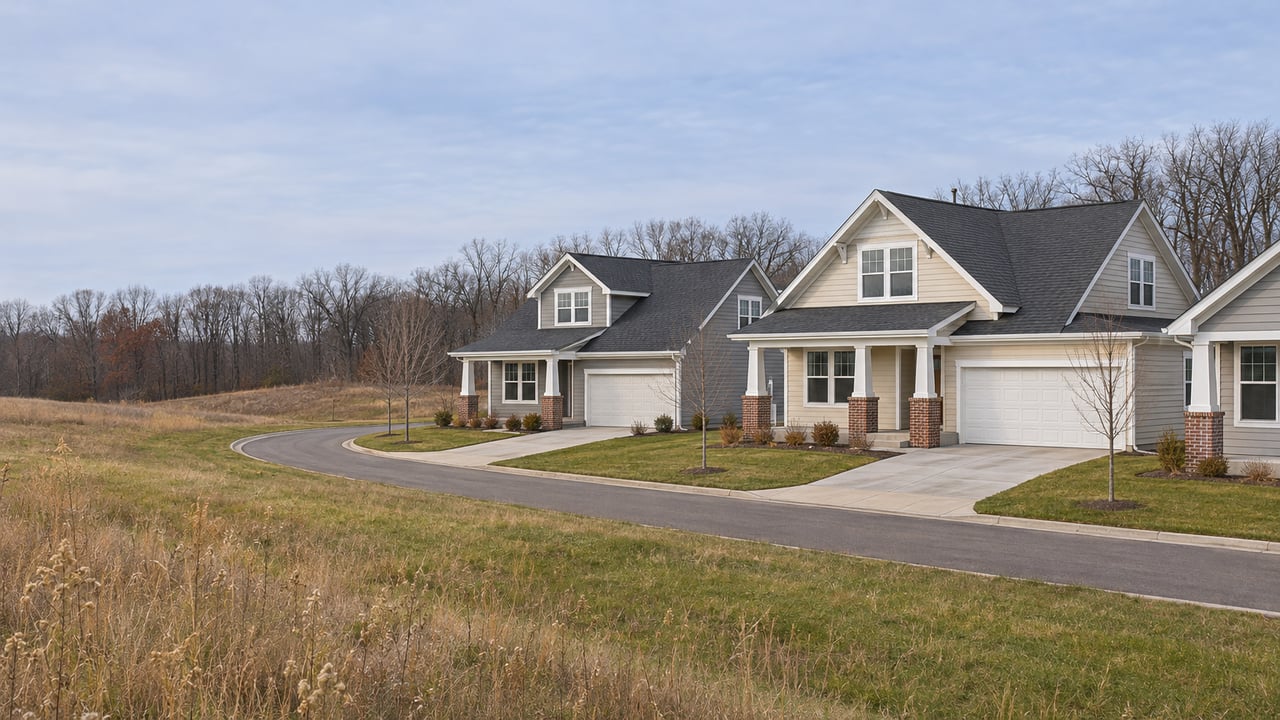
Short answer: No one can say for sure, but the recent numbers give strong clues. Madison is adding the most people by far, and the ring of communities around it, like Cottage Grove, DeForest, Verona, Windsor and Fitchburg, is growing the fastest. Growth tends to go where there is land, sewer and roads to build on, and jobs nearby.
Here is how that works, in plain terms.
Dane County is still the state's growth engine
Start with the big picture. According to the Wisconsin Department of Administration (DOA):
Dane County had 561,504 people in the 2020 Census.
By January 1, 2025, it had an estimated 611,149. That is 49,645 more people, or 8.84% growth.
That was the biggest gain of any Wisconsin county, both in number of people and by percent.
Looking ahead, the DOA's projection shows Dane County reaching 779,265 people by 2050. A group of local planners, working through the Capital Area Regional Planning Commission, made its own projection in 2025. It shows 887,000 by 2050, because they found growth has been speeding up a little over time.
So the question is not really whether Dane County will grow. It is where the new homes and new neighbors will go.
Where growth has been fastest since 2020
The best clue to the next ten years is what has happened over the last five. Here is how the county's larger cities and villages changed from 2020 to January 2025, using DOA estimates.
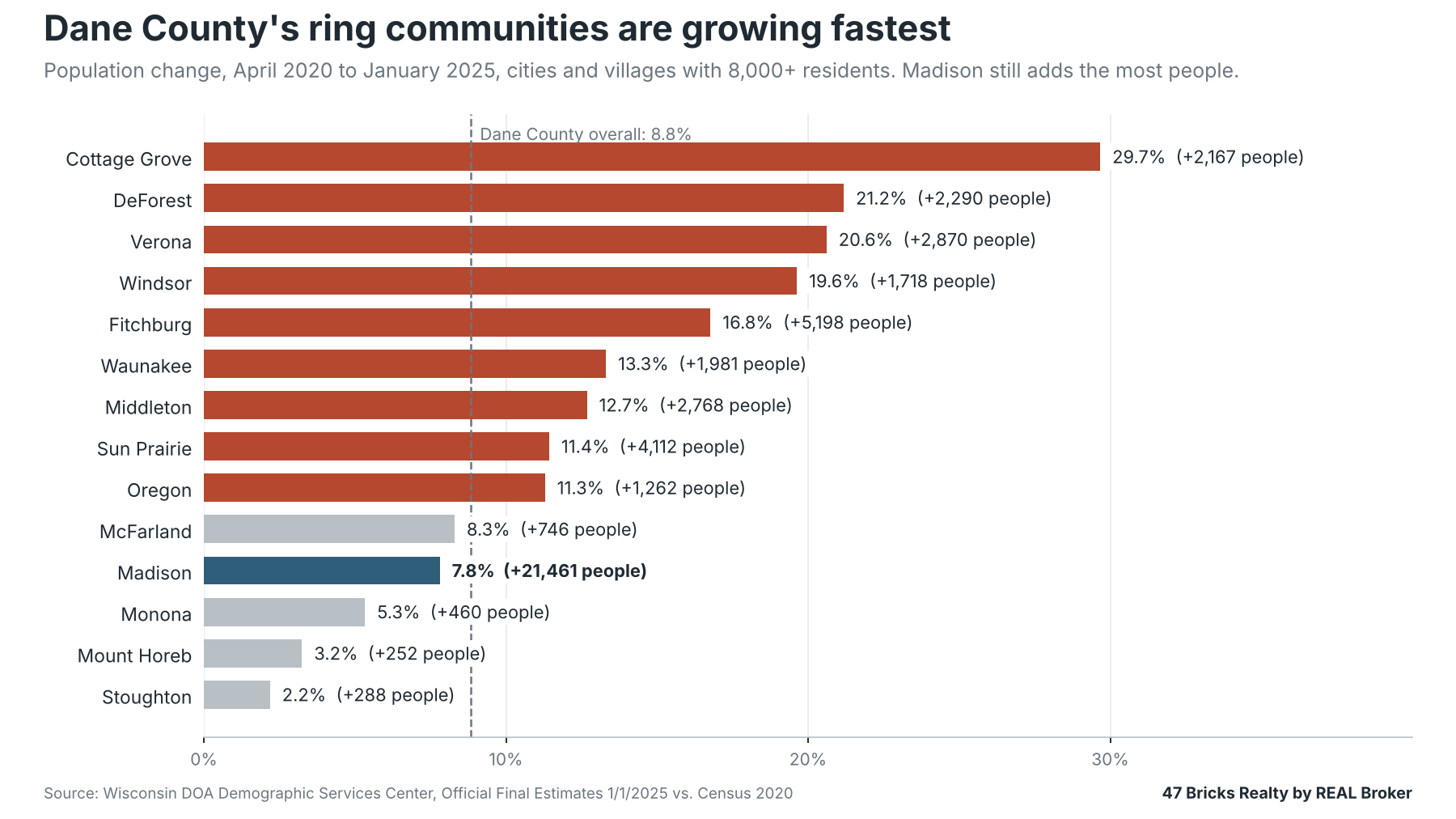
Cottage Grove: up 29.67%, from 7,303 to 9,470 people.
DeForest: up 21.18%, from 10,811 to 13,101.
Verona: up 20.61%, from 13,926 to 16,796.
Windsor: up 19.63%, from 8,754 to 10,472.
Fitchburg: up 16.77%, adding 5,198 people.
Sun Prairie: up 11.43%, adding 4,112 people.
Compare that with places that grew more slowly. Stoughton grew 2.19%, Mount Horeb 3.25%, and Monona 5.33%.
Madison still adds the most people
Percent growth is only half the story. A small village can grow 20% by adding a few thousand people. Madison is big, so a smaller percent means a lot more people.
The City of Madison grew 7.81% from 2020 to 2025, adding 21,461 people. That is more than all six fast-growing communities above combined.
Madison created 2,328 net new homes in 2025, above its 2015 to 2024 average of 2,142, according to the city.
At the end of 2025, another 5,320 homes were permitted and under construction.
The city's goal is 15,000 new homes of all types by 2030.
Most of those new homes are apartments and other multi-unit buildings. Only 188 of the 2025 homes were detached single-family houses, though new single-family neighborhoods are still being built on the city's east and west sides.
Why the ring communities are growing fastest
This comes down to basic supply and demand. People want to be near Madison's jobs. Homes can only be built where three things line up:
Open land. Communities on the edge of the metro still have farm fields that can become neighborhoods. Built-out places, with little open land left, tend to grow slowly.
Pipes and roads. New subdivisions need sewer, water and streets. Places that extend them can add homes quickly.
Jobs nearby. Verona is a good example. Its net new construction grew 5.3% in the Wisconsin Department of Revenue's 2024 report, the highest in Dane County, with big projects from Epic Systems and Arrowhead Pharmaceuticals plus new apartments and homes.
That same report showed other strong building growth in DeForest (4.98%), Cottage Grove (4.35%), Windsor (3.93%), Waunakee (3.89%) and Sun Prairie (3.33%). A Mad City Dream Homes roundup from early 2026 listed new-construction neighborhoods with homes or lots available in nearly 20 Dane County communities, including four each in Cottage Grove, Fitchburg and Middleton.
What would have to happen for this pattern to change
I don't make predictions. But here is what would have to happen for growth to shift to different parts of the county:
Madison builds even more. If the city reaches its 15,000-home goal, more growth would stay in the city. One Madison alder has noted that if the city falls short, people may be pushed to outer towns or neighboring counties.
The edges run short of land or services. If a fast-growing village runs out of approved land, sewer room or road capacity, growth would slow there and move elsewhere.
Jobs move. A big new employer in one area, or job losses in another, would change where people want to live.
Without changes like those, the most likely pattern is more of the same: Madison adding the most people, and the ring communities growing fastest by percent.
What this means for you
If you're buying: Fast-growing communities usually have the most new-construction choices. Compare total cost, including commute, taxes and HOA fees, not just the price.
If you're selling in a growing area: New homes nearby can be your competition. Pricing and condition matter, because buyers can compare your home with brand-new ones.
If you're selling in a slower-growing area: Less new building nearby can mean fewer competing listings. That can work in your favor.
Have a question about your own situation? Call or text me at 608.213.3654.
Sources
Wisconsin Department of Administration, Demographic Services Center, Official Final Estimates, 1/1/2025, Wisconsin Municipalities, with Comparison to Census 2020 (October 2025)
Wisconsin Department of Administration, Demographic Services Center, Official Final Estimates, 1/1/2025, Wisconsin Counties, with Comparison to Census 2020 (October 2025)
Capital Area Regional Planning Commission and Dane County Planning and Development, Regional Population Projections 2020 to 2050 (webinar, November 20, 2025)
City of Madison, District 19 blog, New Population Growth Estimates (November 24, 2025)
City of Madison, 2025 Housing Tracker Year in Review: New homes surpass annual average, focus on affordability (January 7, 2026)
InBusiness Madison, City of Verona ranks No. 1 in Dane County for net new construction (Wisconsin Department of Revenue 2024 Net New Construction report)
Mad City Dream Homes, Dane County new construction home opportunities in 2026 (February 3, 2026)