Short answer: More homes come up for sale, and more supply takes some pressure off prices. But researchers expect older owners to sell slowly, over ten years or more, not all at once. In a tight market like Dane County, that is more likely to cool price growth over time than to make prices fall.
Here is how that works, in plain terms.
Older owners hold a lot of homes
Baby boomers are a big generation, and they own a big share of America's homes.
In 2022, boomers made up 21% of the U.S. population but 38% of homeowner households, according to Freddie Mac.
Realtor.com estimates that boomers and the generation before them own about 36.7 million owner-occupied homes in 2026.
By 2036, Realtor.com expects that number to drop to 22.8 million. That is 13.9 million homes changing hands, or about 1.39 million a year.
That is a real shift. Realtor.com says it is about 5.9 million more homes than older owners released in the past ten years.
A tide, not a tsunami
You may have heard this called the "silver tsunami." The research says it will feel more like a slow tide.
Freddie Mac projects 9.2 million fewer boomer homeowner households by 2035, but only 2.7 million fewer by 2028. Most of the change comes later.
Realtor.com expects yearly releases to grow from about 1.27 million homes in 2027 to 1.52 million by 2036.
Older owners are staying put longer. Cotality found that over 22% of homeowners born in 1938 moved out between ages 65 and 75, but only 17% of those born in 1946 did.
Sellers lived in their homes a median of 12 years before selling, an all-time high, according to the National Association of REALTORS 2026 Profile of Home Buyers and Sellers.
Why stay? Redfin found that 57.8% of baby boomer homeowners have no mortgage at all. A paid-off home is cheap to live in, and many people want to stay near friends and family.
Many boomer sellers are also buyers
Here is a piece people often miss. When an older owner sells, they still need a place to live.
In NAR's 2026 Generational Trends report, boomers were 55% of home sellers and 42% of home buyers. If someone sells a Dane County home and buys another one here, they add one listing and take one away. The net change in supply is close to zero.
The homes that truly add supply come when an owner moves into senior housing, moves in with family, leaves the area, or passes away. Those changes happen one household at a time.
Which homes will come up for sale
The type of home matters as much as the number.
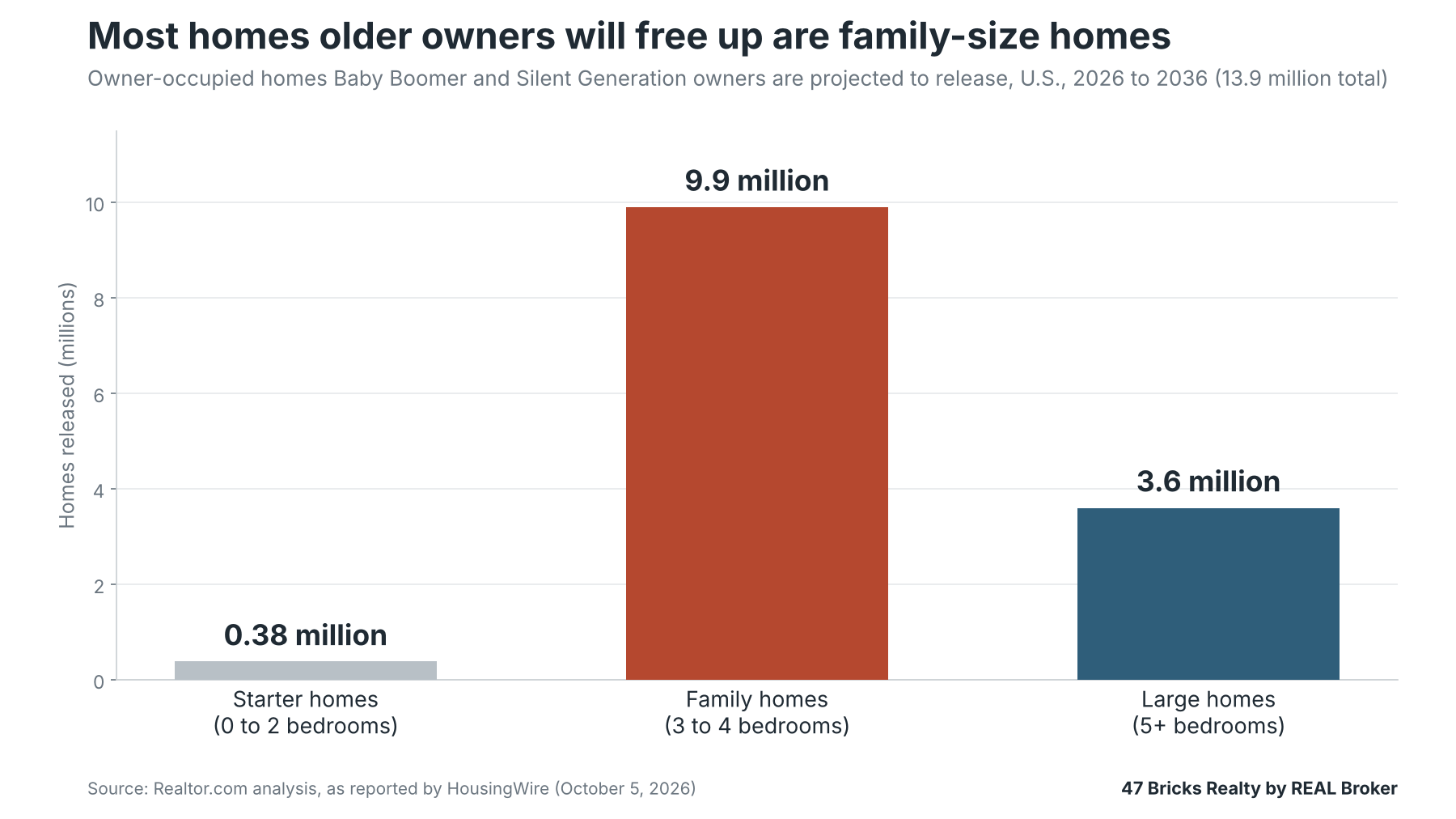
Family homes (3 to 4 bedrooms): about 9.9 million, or 71% of the total.
Large homes (5 or more bedrooms): about 3.6 million.
Starter homes (0 to 2 bedrooms): only about 0.38 million. Older owners hold about 1.33 million starter homes, but Realtor.com expects them to release less than a third.
So the biggest help goes to move-up buyers and growing families. First-time buyers looking for a small, lower-priced home will see much less of it. Many older owners who downsize will be shopping for those same smaller homes.
What this could mean in Dane County
Researchers say this shift may show up sooner in the Midwest. NAHB has found that turnover from older households is happening most quickly in the Rust Belt and Midwest, according to HousingWire. Bright MLS chief economist Lisa Sturtevant has noted that most homeowners age 70 and older live in more affordable Midwest metros.
But Dane County starts from a short supply. According to Mad City Dream Homes, using South Central Wisconsin MLS data:
The Madison area had about 2.1 months of single-family supply in early October 2026.
The median single-family price in September was $508,950, up 6% from a year earlier.
Active single-family listings were 975 on November 10, up 27% from a year earlier, while October accepted offers were the lowest for any October since 2011.
Condo supply was 3.4 months in early October, the highest in several years.
Those listing gains have many causes, and the data does not say how much comes from older owners. Still, it shows how extra supply plays out here: buyers get more choices, and homes that are priced too high sit longer.
What would have to happen for prices to drop
I don't make price predictions. But here is what would have to happen for boomer selling to push Dane County prices down:
Many owners selling at once and leaving the area. The research points to a slow, steady pace instead.
Fewer new buyers. Harvard's Joint Center for Housing Studies projects about 859,000 new U.S. households a year, down from about 1.2 million a year since 2000. Slower household growth means less demand to soak up new listings.
A real hit to local jobs. Dane County still draws people for work at UW-Madison, in state government, health care and tech.
Without those, Sturtevant has said the new supply is more likely to ease price growth instead.
What this means for you
If you're buying: More long-held family homes may come up over the next decade. Many will need updating, which can be a chance to add value.
If you're an older homeowner: There is no need to rush, but know that you may be competing with other downsizers for smaller, one-level homes.
If you're selling a family home: Buyers will have more choices over time. Good pricing and good condition will matter more.
Have a question about your own situation? Call or text me at 608.213.3654.
Sources
Freddie Mac, Aging Boomers and the Impact on the Housing Market Over the Next Decade (February 26, 2024)
HousingWire, 'Silver tsunami' set to free up 13.9 million homes, but first-time buyers will see limited help (October 5, 2026; Realtor.com analysis)
Pro Builder, Silver Tsunami May Not Be Enough to Improve Housing Affordability (January 22, 2026; Cotality research)
Real Estate News, Where demographic shifts could impact home prices, supply (July 14, 2026; Bright MLS and NAHB)
RISMedia, Retirees Reign Over Homebuying as First-Timers Remain Older Than Historical Norms (November 5, 2026; NAR 2026 Profile of Home Buyers and Sellers)
The National News Desk, Boomers 'holding the cards' in a housing market saddled with affordability challenges (April 16, 2026; NAR 2026 Generational Trends)
RISMedia, Out With the Old? Not Quite, When It Comes to Who Owns Homes (April 6, 2026; Redfin)
Mad City Dream Homes, Madison Area Single Family Home Trends for September, 2026 (South Central Wisconsin MLS data)
Mad City Dream Homes, A quick look at the October home and condo markets (November 10, 2026)
Mad City Dream Homes, Madison area condo market trends for September, 2026