Short answer: Higher rates do cut what buyers can pay. But they also keep a lot of owners from selling, so the number of homes for sale shrinks too. In Dane County, steady jobs keep buyers coming, so homes stay scarce and prices hold up.
Here is how that works, in plain terms.
Rates shrink buying power
Most buyers shop by monthly payment, not by price. When rates go up, the same payment buys a smaller loan.
Here is a simple example. These are round numbers to show the idea, not a loan quote. Say a buyer can spend $2,500 a month on principal and interest on a 30-year loan:
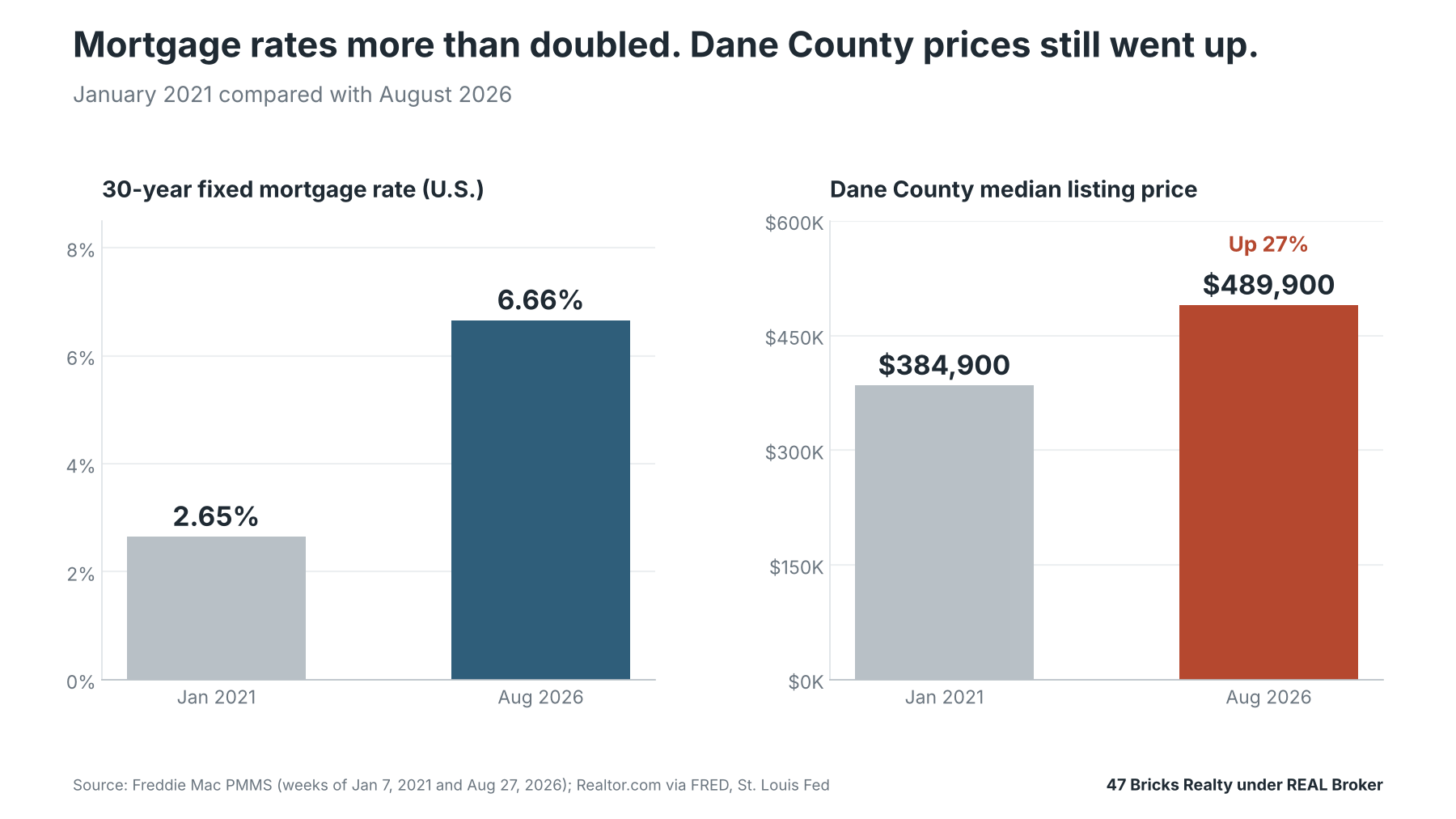
At 2.65%, the record low in January 2021, that payment covers a loan of about $620,000.
At 7.40%, the average rate for the week of October 15, 2026, it covers about $361,000.
That is a big drop in buying power. In a simple supply and demand model, that should pull prices down. Fewer dollars chasing the same homes means lower prices.
But the number of homes did not stay the same.
Rates also shrink the number of sellers
Most homeowners have a fixed-rate loan. If they sell, they give up their low rate and take a new loan at today's rate. Many decide to stay put. This is the "lock-in effect." I covered it in more detail in an earlier post.
Researchers at the Federal Housing Finance Agency (FHFA) measured both sides of this:
For every 1 percentage point that market rates sit above an owner's rate, the chance that owner sells drops by 18.1%.
Lock-in prevented about 1.33 million U.S. home sales from mid-2022 through the end of 2023.
Higher rates on their own pushed prices down 3.3%. But fewer homes for sale pushed prices up 5.7%.
So the supply effect was bigger than the rate effect. Higher rates took buyers out of the market, but they took sellers out too.
Buyers adjust before prices do
When buyers lose buying power, prices don't have to fall right away. Buyers change their plans first:
They look at smaller homes or homes that need some work.
They widen their search to more towns.
They put more money down, or they pay cash.
Cash buyers don't feel rates directly. In 2024, 17% of Dane County single-family sales were cash purchases, according to Mad City Dream Homes. That was down from 22% in 2023, but up from 10% in 2019.
Dane County's jobs keep demand steady
Rates are set by national forces. Demand for homes here is set by local jobs. Dane County's unemployment rate was 2.9% in July 2026 (preliminary), according to the Wisconsin Department of Workforce Development. When most people who want work have it, there is a steady line of buyers.
That shows up in the local numbers. In the Madison area:
As of July 7, 2026, there was about 1.8 months of supply of single-family homes. That means buyers have very few homes to choose from.
The June 2026 median single-family price was $537,300, up 7% from a year earlier.
In May 2026, 37% of single-family contracts involved multiple offers. That is down from 57% in May 2021, when rates were very low.
That last number shows rates do matter. Bidding wars are less common than they were. The market cooled, but it did not flip.
Where rates do show up
Rates leave marks, just not big price drops. Asking prices move up and down during the year. The Dane County median listing price was $522,450 in March 2026 and $489,900 in August 2026, according to Realtor.com data. Some of that is the normal seasonal pattern, but it shows sellers can't push prices as fast as before.
Condos feel it more. In 2026, condo price per square foot in Dane County was down about 0.5%, while single-family price per square foot was up about 3%, according to Mad City Dream Homes. In July 2026, condos had about 2.5 months of supply, compared with 1.8 months for single-family homes.
What would have to happen for rates to bring prices down?
I don't make predictions about rates or prices. But here is what would have to happen for high rates to push Dane County prices down in a real way:
High rates plus a lot more listings. If owners started selling in bigger numbers while rates stayed high, buyers would have more choices and more room to bargain.
A real hit to local jobs. If unemployment rose sharply, fewer people could buy, and some owners would have to sell.
Several years of building more homes than people need. Dane County has not done that in a long time.
Without one of those, high rates tend to slow price growth rather than reverse it.
What this means for you
If you're buying: Don't count on high rates to bring prices down for you. Focus on the payment you can live with, and get pre-approved so you can move when the right home shows up.
If you're selling: Buyers have less buying power than a few years ago, so price matters more. Homes priced right still draw strong interest.
If you're waiting for rates to fall: Lower rates help with payments, but they can also bring more buyers back. Run the numbers both ways before you decide to wait.
Have a question about your own situation? Call or text me at 608.213.3654.
Sources
Freddie Mac, Mortgage Rates Hit a New Record Low the First Week of 2021 (January 7, 2021)
Freddie Mac Primary Mortgage Market Survey, weekly 30-year fixed rates, via Mortgage News Daily and FRED, Federal Reserve Bank of St. Louis (weeks of August 27 and October 15, 2026)
Realtor.com, Housing Inventory: Median Listing Price in Dane County, WI, via FRED, Federal Reserve Bank of St. Louis
Federal Housing Finance Agency, Working Paper 24-03: The Lock-In Effect of Rising Mortgage Rates
Mad City Dream Homes, Madison area home prices end the year higher (January 10, 2025)
Mad City Dream Homes, Madison area single family home trends for June, 2026
Mad City Dream Homes, How are the Madison area home and condo markets different in 2026? (July 13, 2026)
Wisconsin Department of Workforce Development, July Local Employment and Unemployment Data Released (2026)