Short answer: Mortgage rates tend to rise and fall with the yield on the 10-year Treasury, a government bond. Lenders add a gap on top of that yield to cover the extra risks of a home loan. Right now both the yield and the gap are higher than usual, and that is a big reason rates in the 7% range have stuck around.
Here is how that works, in plain terms.
What the 10-year Treasury is
When the U.S. government borrows money, it sells bonds. The 10-year Treasury is a loan to the government that gets paid back in 10 years. Its "yield" is the interest rate investors earn on it.
That yield changes every day, based on what investors think about inflation, the economy, and how much the government needs to borrow.
On October 5, 2026, the 10-year yield hit a recent peak of 5.31%, according to HousingWire.
By October 29, it had eased to about 4.92%, according to Mortgage News Daily.
Why your mortgage follows a bond, not the Fed
Most home loans do not get sold to investors one at a time. They get bundled into mortgage bonds. The investors who buy those bonds could buy Treasuries instead, so they compare the two.
A 30-year mortgage almost never lasts 30 years. People sell, move, or refinance long before that. So investors treat a mortgage more like a 10-year bond than a 30-year one. That is why the 10-year Treasury is the benchmark lenders watch.
The Federal Reserve sets a short-term rate for overnight loans between banks. That rate matters, but it does not set your mortgage rate. On October 28, 2026, the Fed held its rate at 3.75% to 4% and said "inflation remains elevated," according to Admiral Markets. Two of the 12 voting members wanted a hike. For mortgages, what the Fed says about inflation often matters more than the rate itself, because that message is what bond investors react to.
The gap: why mortgages cost more than Treasuries
Lenders and investors charge more for a mortgage than for a Treasury. The extra amount is called the "spread." It pays them for risks a government bond does not have:
Early payoff risk. If rates fall, people refinance. Investors get their money back early and have to reinvest it at lower rates.
Longer-than-expected risk. If rates rise, people stop refinancing, so investors are stuck with a lower-paying loan for longer.
Uncertainty. When the economy or inflation is hard to read, investors want more cushion.
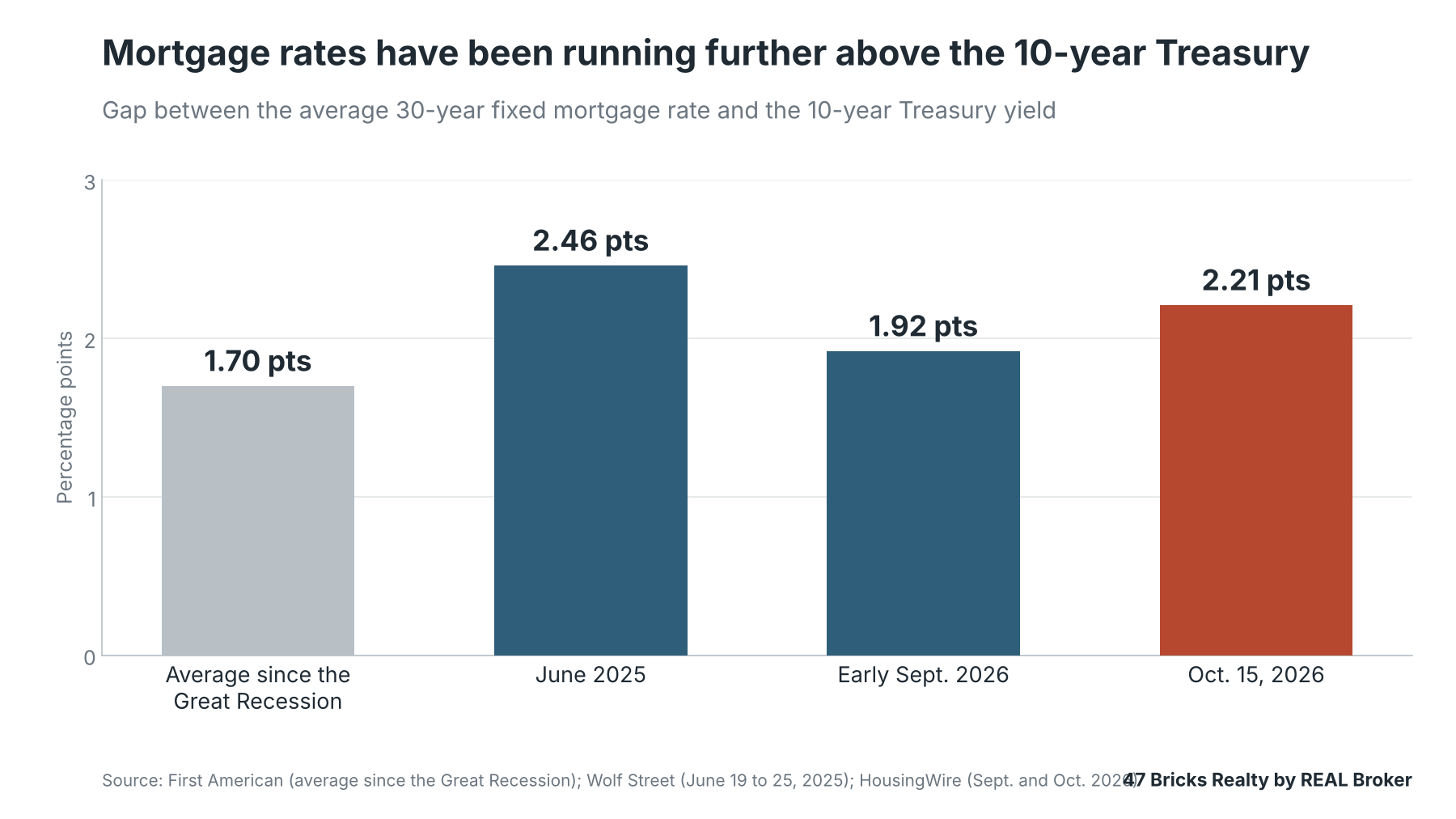
Since the end of the Great Recession, the 30-year rate has averaged about 1.7 points above the 10-year Treasury, according to First American.
Lately it has been wider. HousingWire put the gap at 2.21 points on October 15, 2026, up from a recent low of 1.92 points in early September. In June 2025 it was 2.46 points, according to Wolf Street. Back in September 2022 it went past 3 points, the widest since 1986.
One reason for the wider gap: the Federal Reserve was a huge buyer of mortgage bonds during the pandemic, which kept the gap narrow. It stepped away from buying them in September 2022. With one big buyer gone, the remaining investors ask for more.
Where things stand right now
10-year Treasury: about 4.92% on October 29, 2026.
Average 30-year mortgage: 7.24% for the week of October 29, 2026, down from 7.40% in early and mid October, according to Freddie Mac. A year earlier it was 6.17%.
Notice how the two moved together. As the 10-year yield came down from its early October peak, the weekly mortgage average slipped too.
What the gap means in Madison dollars
The median single-family price in the Madison area was $508,950 in September 2026, up 6% from $480,000 a year earlier, based on South Central Wisconsin MLS data. Here is a simple example with round numbers. It is not a loan quote.
With 20% down, the loan is about $407,000. Monthly principal and interest on a 30-year loan would be about:
At 7.24% (this week's average): $2,775
At 6.62% (this week's 10-year yield plus the usual 1.7 point gap): $2,606
So the extra-wide gap alone is worth roughly $170 a month on a typical Madison home. That is money that has nothing to do with the house, and everything to do with the bond market.
What would have to happen for mortgage rates to fall?
I don't predict rates. But for 30-year rates to come down in a lasting way, one or both of these pieces would have to shrink:
The 10-year yield falls. That usually takes cooler inflation, a slower economy, or both.
The gap narrows. That usually takes calmer markets and less uncertainty, so investors need less cushion to buy mortgage bonds.
Keep in mind what lower rates would do here. The Madison area had about 2.1 months of single-family supply in early October, with 937 homes for sale. A balanced market is usually 4 to 6 months. Cheaper money would bring more buyers to a small number of homes.
What this means for you
If you're buying: Watch the 10-year Treasury, not just Fed headlines. When it moves, rate quotes tend to follow.
If you're shopping lenders: The gap is not fixed. Lenders price it differently, so comparing a few quotes on the same day can pay off.
If you're waiting for lower rates: Remember there are two pieces. The yield and the gap both have to cooperate, and buyers who wait for that moment will not be alone.
Have a question about your own situation? Call or text me at 608.213.3654.
Sources
Freddie Mac, Primary Mortgage Market Survey (week of October 29, 2026)
Mortgage News Daily, 10 Year Treasury Yield and Freddie Mac Mortgage Rates (October 29, 2026)
HousingWire, Mortgage rates dip as 10-year Treasury yield slides (October 20, 2026)
First American, Mind the Gap Between Mortgage Rates and the 10-Year Treasury Yield
Wolf Street, The Historically Wide Spread between the 10-Year Treasury Yield and Mortgage Rates Widened Again (June 28, 2025)
Admiral Markets, FOMC October 2026: Fed Holds Rates in a 10-2 Vote (October 28, 2026)
Mad City Dream Homes, Madison Area Single Family Home Trends for September, 2026 (South Central Wisconsin MLS data)