
Short answer: A national slowdown does not move every home's value the same way. Prices fall where there are more homes for sale than buyers, and Dane County still has fewer homes than buyers. So a cooler national market is more likely to slow price growth here than to cut your home's value, unless local supply or local jobs change.
Here is how that works, in plain terms.
The national market is cooling
This fall, the national numbers turned. According to Redfin, for the four weeks ending October 25, 2026:
The typical U.S. home sold for $389,601, down 0.1% from a year earlier. Redfin says that is the first drop in three years.
Pending sales, meaning homes that went under contract, fell 15.9%. That is the lowest level in Redfin's records.
The country had 4.5 months of supply, up from 4 a year earlier. Redfin calls 4 to 5 months balanced.
A separate ResiClub analysis of Zillow data found that 66 of the 300 largest U.S. housing markets had lower home values in September 2026 than a year earlier.
So yes, the national market is cooling. The real question is what that means for one home in Dane County.
Prices fall where homes pile up
A home's value comes down to supply and demand in its own area. When buyers pull back in a place with lots of homes for sale, sellers have to compete, and prices drop. When buyers pull back in a place with few homes for sale, prices tend to level off instead.
You can see that in Redfin's list of large metros. Some of the biggest price drops were in places like Seattle (down 5.1%), Austin (down 4.6%), and Kansas City (down 4.3%). At the same time, prices were still rising in places like Pittsburgh (up 7.4%) and Cleveland (up 4.9%). Same country, same mortgage rates, very different results.
Dane County is on the tight side. In September 2026, the Madison area median single-family price was $508,950, up 6% from $480,000 a year earlier, based on South Central Wisconsin MLS data. Dane County had about 2.1 months of supply. That is well below the balanced range.
The part of the national market that does reach Madison
Some national forces hit every market at once. The biggest is mortgage rates. Rates are set in national bond markets, so a buyer in Madison pays about the same rate as a buyer in Seattle. The average 30-year rate was 7.32% in late October, according to the Freddie Mac numbers Redfin uses.
Higher rates have cooled demand here, too. In September 2026, Madison area accepted offers fell 15% from a year earlier, from 431 to 367. Homes for sale rose 8%, from 868 to 937.
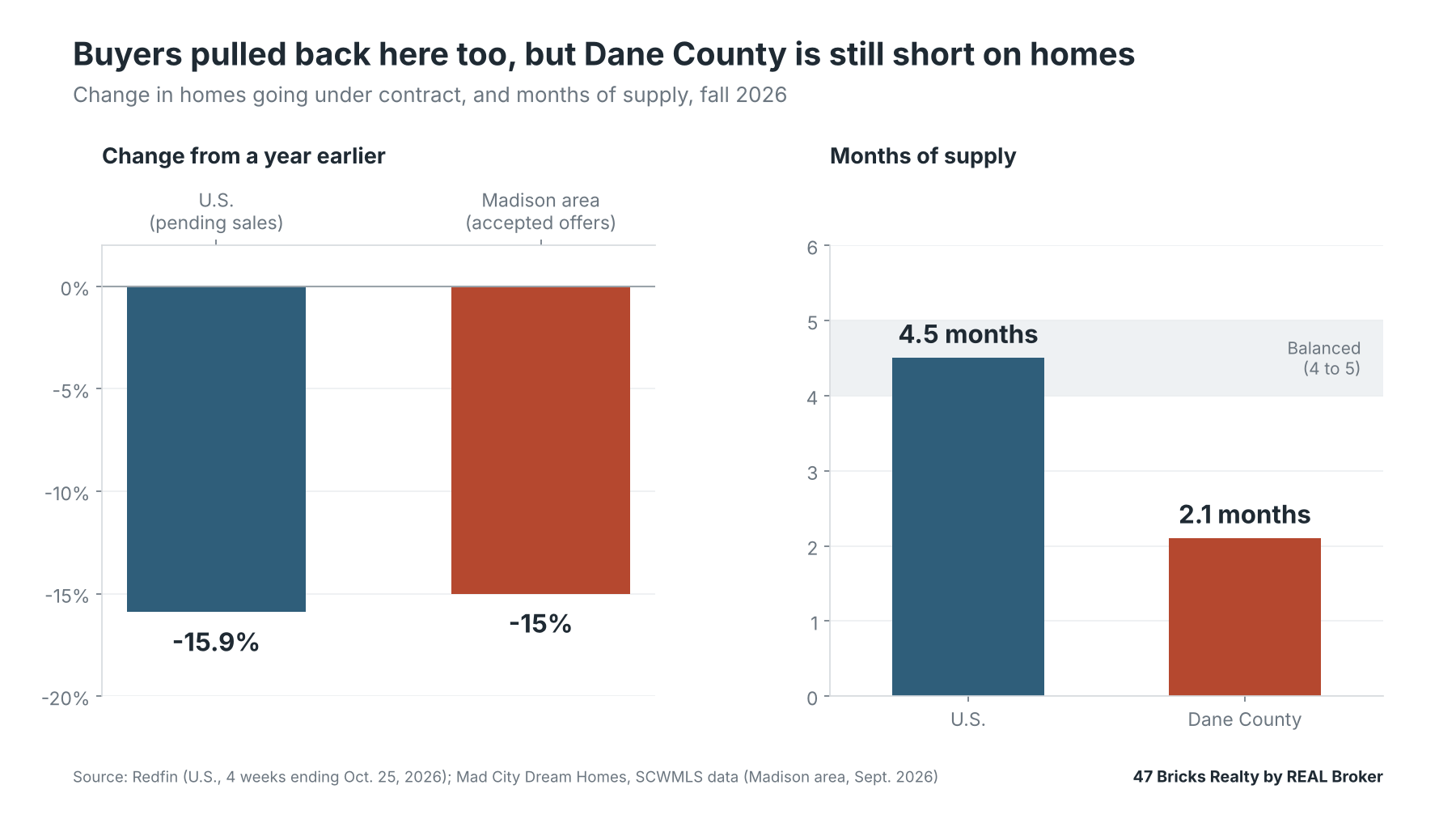
So Dane County buyers pulled back about as much as buyers across the country. The difference is supply. Nationally, the market is close to balanced. Here, there are still fewer homes than buyers.
What would have to happen for values to fall here
I don't make price predictions. But here is what would have to happen for a national slowdown to push Dane County values down in a real way:
A big jump in homes for sale. If listings kept rising while buyers stayed on the sidelines, months of supply would climb toward the balanced range, and sellers would have less pricing power.
A hit to local jobs. A national slowdown that turned into job losses here would mean fewer buyers and more forced sales.
Buyers staying away for a long time. One slow season does not change values much. A long stretch of weak demand could.
There are early signs worth watching. New listings in September were down 6% from a year earlier, but expired listings through September were up 12%, from 609 to 680. Homes that are priced too high are sitting. That tells you buyers are pickier, even while the overall market stays tight.
Your home's value is a number until you sell
Here is a point that gets lost in the headlines. A dip in value only costs you money if you sell or borrow against the home at that moment. If you stay put and keep paying your mortgage, a short dip does not change your monthly payment.
Most owners also have a large cushion. According to Cotality, in early 2026:
The average U.S. homeowner with a mortgage had $310,500 in equity.
Only 1.9% of mortgaged homes owed more than the home was worth. At the peak in late 2009, it was 26%.
Cotality estimated that a 5% national price drop would push only about 188,000 more homes below that line.
That cushion is a big reason today's slowdown looks different from 2008. Fewer owners are forced to sell, so fewer homes flood the market at low prices.
What this means for you
If you're staying put: A national slowdown is mostly noise for you. Your home's value matters most when you sell or borrow.
If you're selling soon: Price for today's buyers, not last spring's. Buyers have a few more choices, and overpriced homes are sitting.
If you're buying: A cooler national market may give you more room to negotiate, but don't expect Dane County prices to follow the national headlines.
If you're just watching: Track local months of supply and accepted offers. Those tell you more about your home's value than any national number.
Have a question about your own situation? Call or text me at 608.213.3654.
Sources
Redfin, U.S. Home-Sale Prices Just Fell for the First Time in 3 Years (October 29, 2026)
Fast Company and ResiClub, 66 major housing markets now see falling prices (October 29, 2026)
Mad City Dream Homes, Madison Area Single Family Home Trends for September, 2026 (South Central Wisconsin MLS data, October 12, 2026)
Cotality, US homeowners reach a historic wealth plateau (July 23, 2026)