Short answer: A buydown means paying money upfront to get a lower mortgage rate. One kind lowers your rate for the whole loan; another lowers it for only the first year or two. It makes financial sense when you keep the loan long enough to earn back what you paid, or when someone else, like the seller, pays for it.
Here is how that works, in plain terms.
Two kinds of buydowns
People use the word "buydown" for two different things:
Permanent buydown (discount points). You pay the lender extra at closing, and your rate is lower for the life of the loan. One point costs 1% of the loan amount, according to the Consumer Financial Protection Bureau (CFPB).
Temporary buydown. Money is set aside at closing to cover part of your payment for the first few years. The most common version is a 2-1 buydown: the rate is 2 points lower in year one, 1 point lower in year two, then goes back to the full rate.
How much one point lowers your rate depends on the lender and the market, the CFPB says. Bankrate says a point typically lowers the rate by about 0.25 percentage points. Always ask for the real numbers on your own loan.
Points got more popular as rates rose. The CFPB found the share of home buyers paying points went from about 3 in 10 in 2021 to about 6 in 10 in 2023.
What a buydown looks like on a Madison home
The median single-family home in the Madison area sold for $508,950 in September 2026, based on South Central Wisconsin MLS data. With 20% down, the loan is about $407,160. The average 30-year rate was 7.24% for the week of October 29, 2026, according to Freddie Mac.
Here is a simple example. These are round numbers to show the idea, not a loan quote.
No buydown at 7.24%: about $2,775 a month in principal and interest.
Two points, about $8,140 upfront, for 6.74%: about $2,638 a month, for as long as you keep the loan. That saves about $137 a month.
A 2-1 buydown: about $2,246 a month in year one, $2,504 in year two, then $2,775 from year three on. Covering that gap costs about $9,590 upfront.
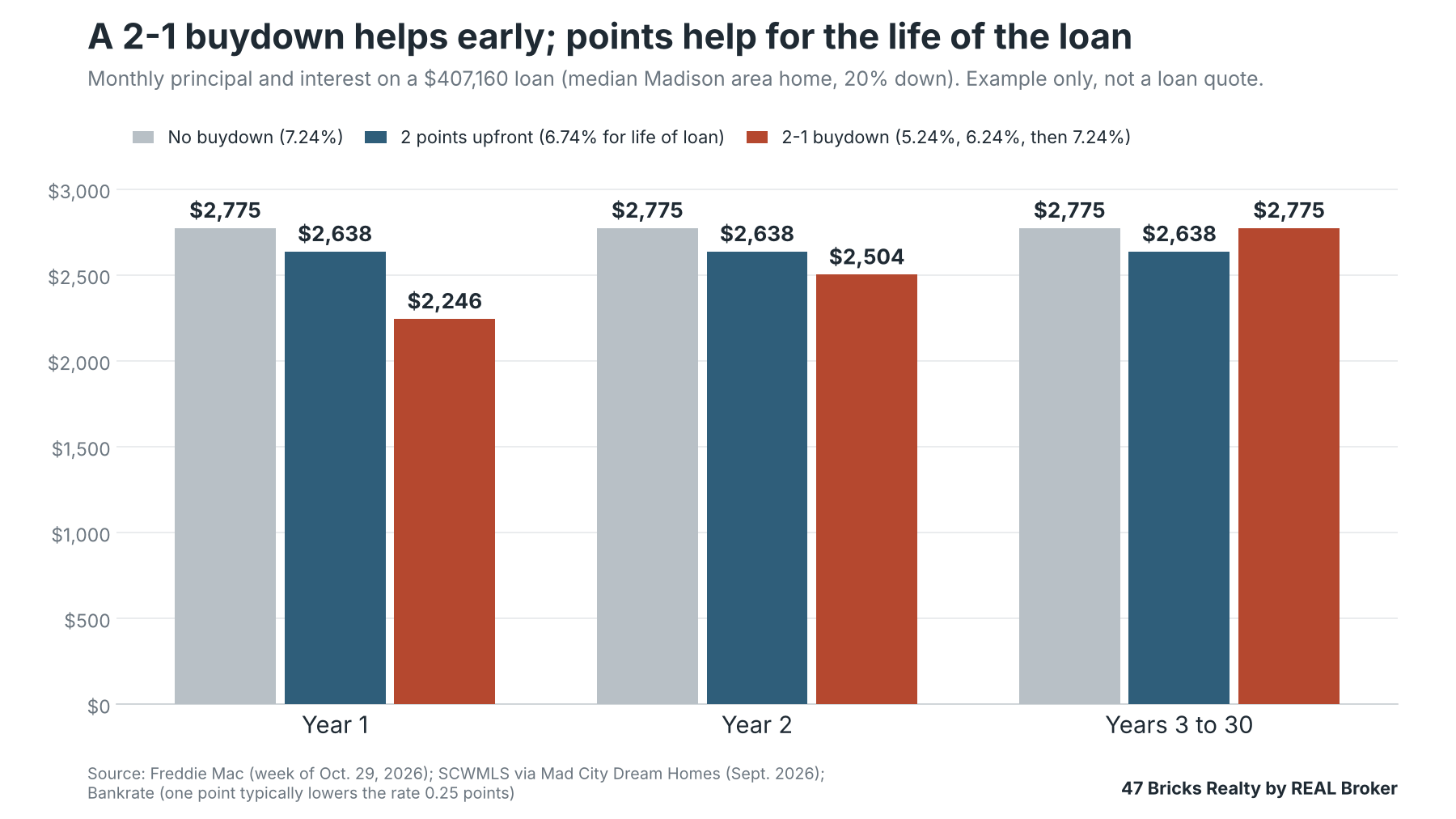
Notice the trade-off. The 2-1 buydown gives the biggest break right away, but it ends. The points give a smaller break, but it lasts.
The break-even test for points
Buying points is a classic opportunity cost question. Money you spend on points is money you can't use for a bigger down payment, moving costs, or savings.
The test is simple: divide the cost of the points by the monthly savings. That tells you how many months it takes to earn the money back.
In our example, $8,140 divided by $137 is about 60 months, or 5 years.
If you sell or refinance before then, you lose money on the points.
If you keep the loan longer, every month after that is savings.
The CFPB puts it plainly: points can be a good choice if you plan to keep your loan for a long time. Some buyers plan to refinance if rates fall. If that is your plan, points may not pay off. I don't predict rates, but it is worth being honest with yourself about how long you expect to keep this loan.
When a temporary buydown makes sense
A 2-1 buydown is about cash flow, not long-term savings. It can make sense when:
The seller or builder pays for it. Then the early savings cost you nothing.
Your budget is tight in the first two years. For example, while you furnish the home or expect a planned raise.
You might refinance early. Under Fannie Mae rules, if the loan is paid off before the buydown money is used up, the leftover funds are applied to the payoff or returned as the agreement says. So the money is not simply lost.
One important rule: Fannie Mae requires lenders to qualify you at the full note rate, not the lower starting rate. A temporary buydown does not let you borrow more. It just makes the first two years easier. Plan for the full payment from day one.
Who pays: why sellers may say yes this winter
Buyers don't have to pay for a buydown themselves. Sellers can contribute, within limits. For a primary home with a down payment between 10% and 25%, Fannie Mae caps seller and other "interested party" help at 6% of the price. On a $508,950 home with 20% down, that is up to about $30,540, which also covers any help with closing costs.
The market can make sellers more open to it. In September 2026, accepted offers on Dane County single-family homes fell 15% from a year earlier, while homes for sale rose 8%. Supply is still tight at 2.1 months, but buyers have a little more room to ask.
For a seller, paying for a buydown can be a better deal than cutting the price. In our example, a $9,590 price cut would lower the monthly payment by only about $52. A buydown puts that money right where buyers feel it: the payment.
What this means for you
If you're buying and plan to stay a long time: Ask your lender for quotes with and without points, then do the break-even math.
If you think you'll refinance or move within a few years: Skip the points. A seller-paid 2-1 buydown, or help with closing costs, is usually the better ask.
If you're selling: Offering rate help can draw more buyers than a small price cut. Talk through the numbers before you list.
Have a question about your own situation? Call or text me at 608.213.3654.
Sources
Consumer Financial Protection Bureau, What are discount points and lender credits and how do they work?
Consumer Financial Protection Bureau, Data Spotlight: Trends in discount points amid rising interest rates (April 2024)
Bankrate, Mortgage points: What are they and how do they work? (September 30, 2026)
Fannie Mae Selling Guide, B2-1.4-04, Temporary Interest Rate Buydowns
Fannie Mae Selling Guide, B3-4.1-02, Interested Party Contributions (IPCs)
Mortgage News Daily, Freddie Mac Mortgage Rates (weekly survey through October 29, 2026)
Mad City Dream Homes, Madison Area Single Family Home Trends for September, 2026 (South Central Wisconsin MLS data)