
Short answer: A national headline blends hundreds of very different local markets into one number. Some of those markets are cooling while others, like Dane County, are still short on homes. So a "prices are flat" headline can be true for the country and still miss what is happening here.
Here is how that works, in plain terms.
One number, many different markets
When you read that home prices rose a little or fell a little, that number is usually an average of the whole country. It mixes fast-rising markets with falling ones.
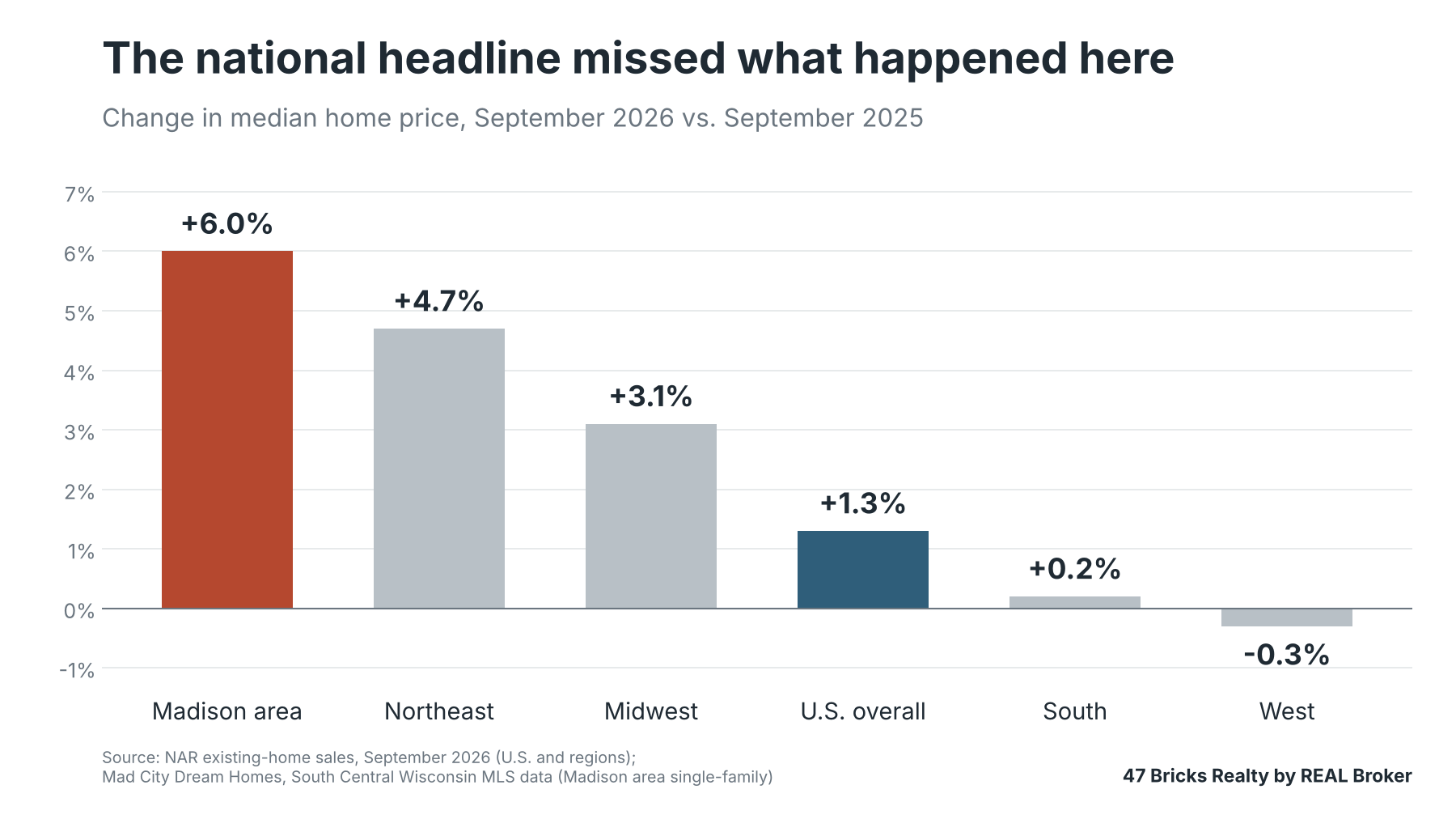
Look at September 2026, according to the National Association of REALTORS (NAR):
U.S. overall: the median existing-home price was $417,500, up 1.3% from a year earlier.
Northeast: up 4.7%.
Midwest: up 3.1%.
South: up 0.2%.
West: down 0.3%.
Now compare the Madison area. The median single-family price was $508,950 in September 2026, up 6% from $480,000 a year earlier, based on South Central Wisconsin MLS data.
The gap shows up city by city, too. In the S&P Cotality Case-Shiller index for August 2026, Chicago prices were up 6.7% from a year earlier, while Seattle prices were down 2.0%. That is a gap of nearly 9 points inside the same national number. Five of the 19 cities with August data had falling prices, including Dallas, Denver, and Las Vegas.
Supply is the biggest difference
Prices come down to supply and demand. The simplest way to measure that balance is "months of supply," meaning how long it would take to sell every home for sale if no new listings came up. A balanced market is usually about 4 to 6 months.
Nationally: 4.8 months of supply in September 2026, up from 4.5 months a year earlier, according to NAR.
Dane County: about 2.1 months of supply for single-family homes.
So the country as a whole is close to balanced. Dane County is still a seller's market. In a place with plenty of homes for sale, buyers can push prices down. Here, there are still fewer homes than buyers, so prices keep rising, just more slowly.
Headlines are often old news
Timing matters too. Some of the best-known price reports run a couple of months behind.
The Case-Shiller numbers for August 2026 came out on October 27, 2026.
NAR's quarterly metro report, released October 29, covered July through September.
By the time a headline reaches you, the local market may have shifted. And Madison is not one of the 20 big cities in the Case-Shiller index, so those headlines are not measuring us at all.
Different reports measure different things
Two headlines can both be correct and still seem to disagree. That is because they measure different things:
Which homes are counted. NAR's national median includes condos and single-family homes. The Madison numbers above are single-family homes only.
Median price vs. price per square foot. The median is the middle sale. If more large homes sell in a month, the median jumps even if values did not change much. In September, the Madison area median was up 6%, but the price per square foot was up 2%, from $249 to $255.
Before or after inflation. Case-Shiller reported that national prices rose 2.1% in the year through August, while consumer prices rose 3.4%. After inflation, home prices fell for the 15th straight month. A headline about "falling real prices" is talking about that, not about sale prices going down.
None of these numbers are wrong. They just answer different questions.
When national news does matter here
Some national news hits Dane County directly. The biggest one is mortgage rates. Rates are set in national bond markets, so a buyer in Madison pays about the same rate as a buyer in Dallas.
That is why the Madison market does feel national trends. In September, accepted offers in the Madison area fell 15% from a year earlier, from 431 to 367. Homes for sale rose 8%, to 937. And 24% of Dane County contract signings in August involved multiple offers, down from 26% a year earlier and 38% in August 2021.
So higher rates have cooled demand here too. They have just not been enough to turn a tight market into a soft one.
What this means for you
If you're buying: Don't wait for a national price drop to show up here. Watch local numbers, like months of supply and how many homes have competing offers.
If you're selling: A cooler national headline does not mean your home is worth less. But Dane County buyers are more careful than a few years ago, so pricing right still matters.
If you're just watching: When you see a national headline, ask three questions: Which homes does it count? Which months does it cover? Is it before or after inflation?
Have a question about your own situation? Call or text me at 608.213.3654.
Sources
National Association of REALTORS, September 2026 existing-home sales, as reported by Mortgage News Daily (October 16, 2026)
National Association of REALTORS, Home Prices Rise in 78% of Metro Areas in Third Quarter of 2026 (October 29, 2026)
S&P Dow Jones Indices, S&P Cotality Case-Shiller Index Reports Annual Gain in August 2026 (October 27, 2026)
Mad City Dream Homes, Madison Area Single Family Home Trends for September, 2026 (South Central Wisconsin MLS data)