Short answer: It depends mostly on what home prices do. Paying down your loan adds a steady but modest amount, about $22,400 in five years on a $400,000 loan at today's rates. Rising prices can add far more. From 2020 to 2025, Dane County home prices rose about 54%, but from 2005 to 2010 they slipped about 1%.
Here is how that works, in plain terms.
What equity is
Equity is the part of your home you own outright. It is your home's value minus what you still owe on the mortgage.
It grows in three ways:
Your down payment. That is equity from day one.
Paying down the loan. Part of each payment lowers what you owe.
Rising value. If your home is worth more, your equity grows even if your loan stays the same.
To keep it simple, let's use one example home. Through June 2026, the median price of a single-family home in the Madison area was $500,000, up 5% from $476,000 a year earlier, based on South Central Wisconsin MLS data reported by Mad City Dream Homes. Say you buy at that price with 20% down. That is $100,000 down and a $400,000 loan.
Way 1: Paying down the loan
On November 19, 2026, the average 30-year fixed rate was 7.28%, according to Freddie Mac. At that rate, principal and interest on a $400,000 loan come to about $2,737 a month. These are round numbers to show the idea, not a loan quote.
Here is the catch. In the early years, most of each payment goes to interest.
Over five years, you would pay about $164,200 in principal and interest.
Only about $22,400 of that would lower your loan balance.
The other $141,800 or so would be interest.
Rates matter here too. A year earlier, Freddie Mac's average was 6.26%. At that rate, the same loan would be paid down by about $26,600 in five years. A lower rate means less interest and more of each payment going toward what you owe.
So paying down the loan is real, steady progress. But in the first five years, it is not where most equity comes from.
Way 2: Your home's value goes up
This is the big one, and the one nobody controls. The federal home price index for Dane County shows how much five years can vary:
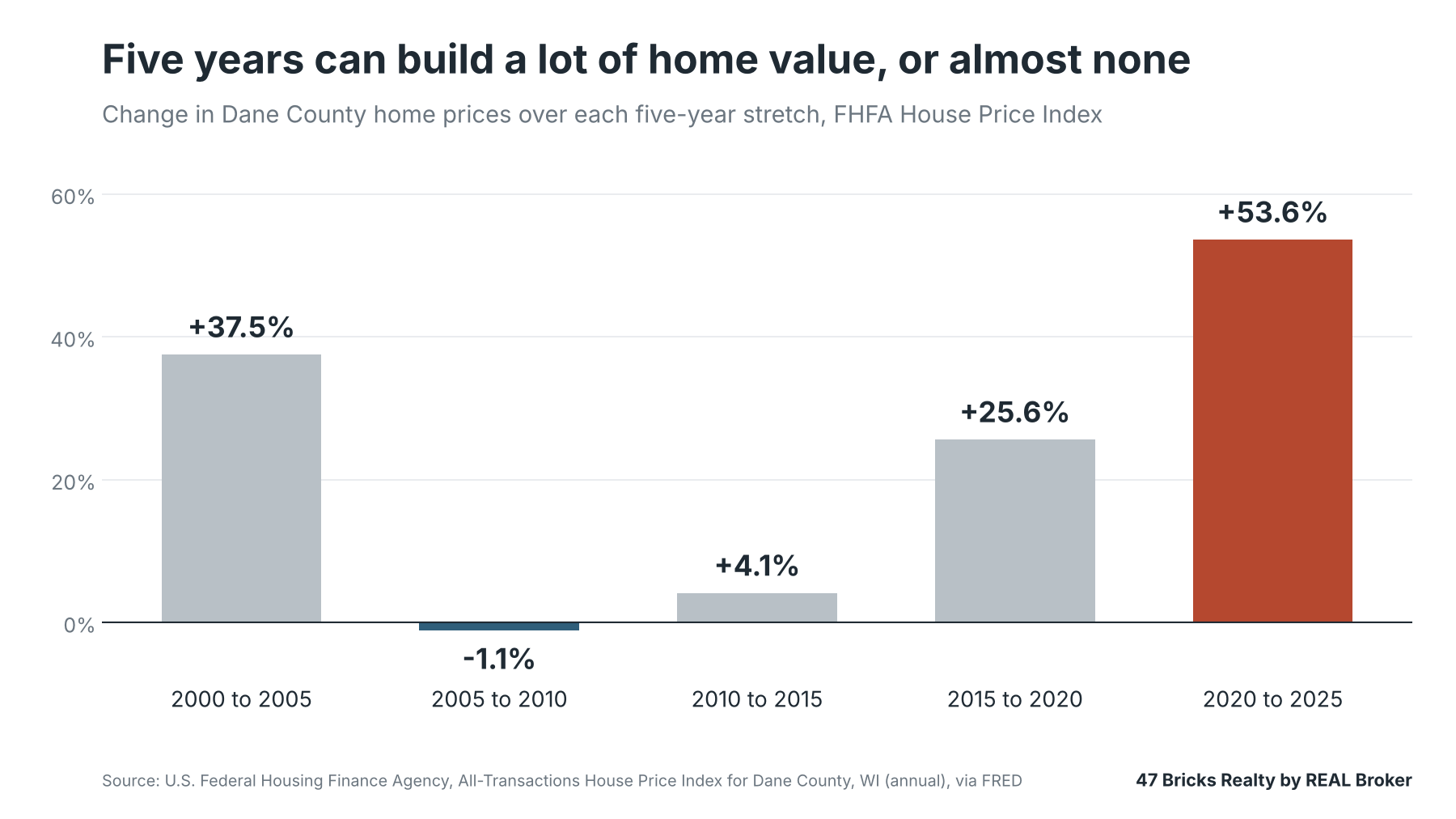
2000 to 2005: up 37.5%
2005 to 2010: down 1.1%
2010 to 2015: up 4.1%
2015 to 2020: up 25.6%
2020 to 2025: up 53.6%
Why such big swings? Prices rise fastest when buyers far outnumber homes for sale. In recent years, Dane County has had strong job growth and too few homes. Around 2010, after the housing crash and recession, it was the other way around: more homes for sale and fewer buyers.
Putting it together: three five-year stories
I don't make price predictions. But we can look at what our example owner's equity would be if the next five years looked like one of the past ones. Each one starts with the $100,000 down payment and about $22,400 in loan paydown.
If prices moved like 2005 to 2010 (down 1.1%): about $116,900 in equity. Almost all of it came from the owner's own money.
If prices moved like 2015 to 2020 (up 25.6%): about $250,300 in equity.
If prices moved like 2020 to 2025 (up 53.6%): about $390,500 in equity.
Same house, same payment, very different results. That is why there is no single "typical" answer. For a national comparison, Cotality reported in September 2026 that the average U.S. homeowner with a mortgage had about $310,000 in equity. Only 2.1% of mortgages were underwater, meaning the owner owed more than the home was worth.
Equity on paper vs. money in your pocket
Equity is not the same as cash. To turn it into money you can spend, you usually have to sell or borrow against it.
Selling costs come out of your equity at closing.
Buying costs on the way in mean a short stay can eat up much of your gain.
Borrowing against equity means a new loan, with interest.
This is the opportunity cost of owning for a short time. If you might move in two or three years, there is less time for loan paydown and price growth to cover the costs of buying and selling.
What this means for you
If you're buying: Plan to stay long enough for equity to work. Five years or more gives both loan paydown and price growth time to add up.
If you already own: Check your home's current value against your loan balance. Many Dane County owners who bought before 2020 have more equity than they think.
If you're thinking about selling: Look at your equity after the payoff and selling costs, not just the sale price. That is the number that pays for your next move.
Have a question about your own situation? Call or text me at 608.213.3654.
Sources
U.S. Federal Housing Finance Agency, All-Transactions House Price Index for Dane County, WI (annual), via FRED, Federal Reserve Bank of St. Louis
Freddie Mac, Primary Mortgage Market Survey (30-year fixed rate, November 19, 2026)
Mad City Dream Homes, Madison area single family home trends for June, 2026
Cotality, Record home equity builds, yet remains untouched by borrowers (September 10, 2026)