Short answer: Often, yes. A 3% loan can save you about $1,050 a month compared with today's rates, and that is hard to give up. But a low rate is not a reason by itself to stay in a home that no longer fits your life. The smart move depends on what the new home would cost you each month and what staying is costing you in other ways.
Here is how that works, in plain terms.
Your low rate is worth real money
On November 19, 2026, the average 30-year fixed rate was 7.28%, according to Freddie Mac. A year earlier, it was 6.26%.
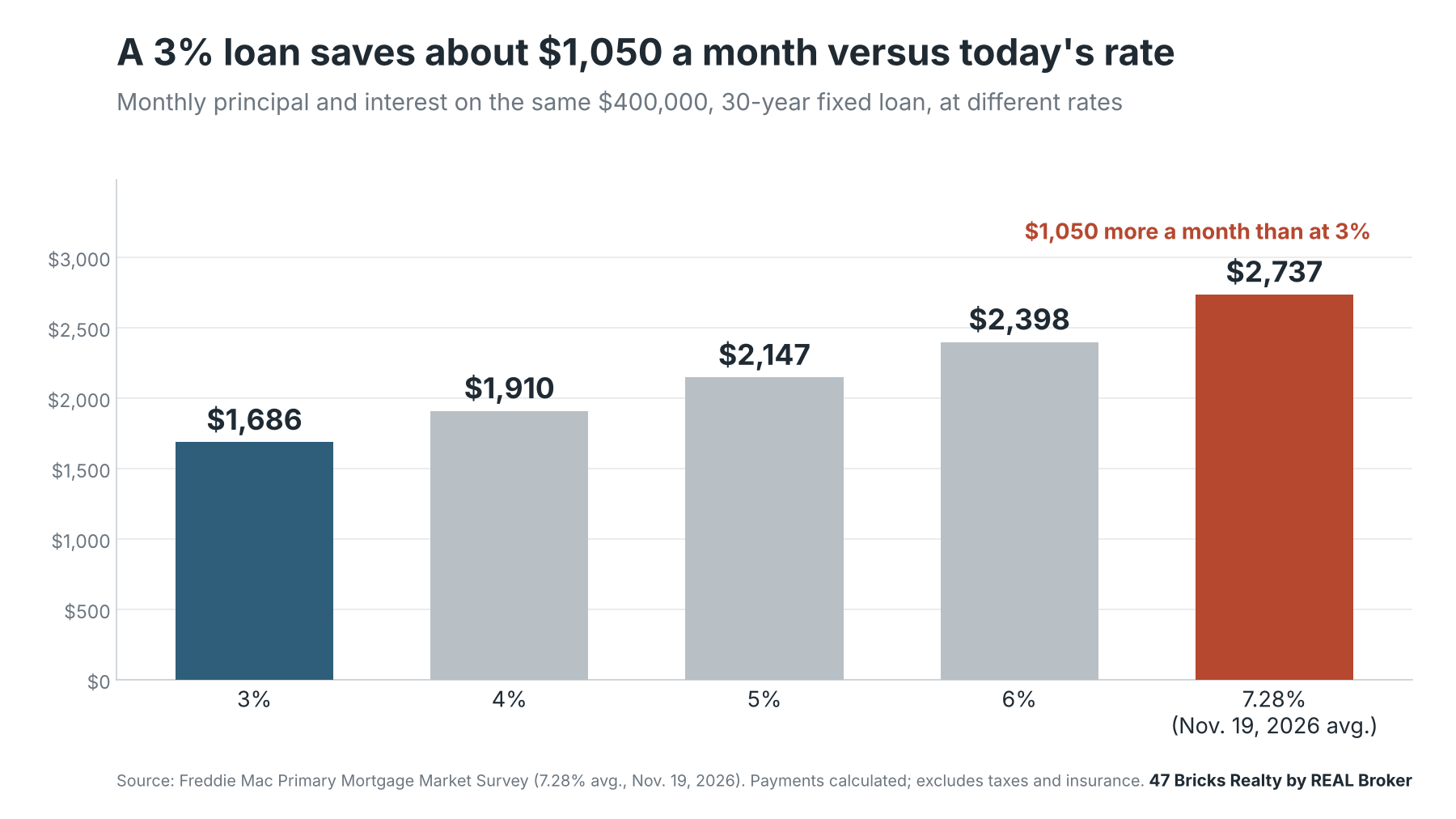
Here is what that gap means on the same $400,000, 30-year loan. These are round numbers to show the idea, not a loan quote.
At 3%: about $1,686 a month in principal and interest.
At 7.28%: about $2,737 a month.
The difference: about $1,050 a month, or about $12,600 a year.
That is why a low rate feels like an asset. In a way, it is one. It lowers your cost of living every single month for as long as you keep it.
You are not alone
Lots of homeowners are in the same spot. As of mid-2026, here is how U.S. mortgages broke down by rate, based on the FHFA National Mortgage Database, as reported by Realtor.com:
19.2% had a rate below 3%.
29.9% were between 3% and 4%.
In total, 65.6% were under 5%.
Economists call this the lock-in effect. When moving means trading a cheap loan for an expensive one, many people stay put. In Dane County, that helps keep the number of homes for sale low. In June 2026, the Madison area had about 1.8 months of single-family homes for sale, based on South Central Wisconsin MLS data reported by Mad City Dream Homes. A balanced market has about 4 to 6 months.
What moving up really costs
Moving up usually means a bigger loan and a higher rate at the same time. That is a double hit.
Say you have that $400,000 loan at 3%, and your next home needs a $450,000 loan at 7.28%. Your principal and interest would go from about $1,686 to about $3,079 a month. That is about $1,393 more each month, before any change in property taxes or insurance.
There are one-time costs too:
Selling costs come out of your sale price at closing.
Wisconsin's transfer fee is $3 for every $1,000 of the sale price, and state law puts it on the seller. On a $500,000 sale, that is $1,500.
Buying costs and moving costs add up on the other side.
And the next home is not cheap. In the first half of 2026, the median single-family price in the Madison area was $500,000, up 5% from $476,000 a year earlier. In June alone, the median was $537,300.
Staying has a cost too
This is the part people forget. Economists call it opportunity cost: what you give up by choosing one path over another.
If your home still works for you, keeping your low rate is a great deal. But if it doesn't fit anymore, staying has a price that never shows up on a statement:
A long commute that eats up time every day.
Not enough space, or too much space to keep up.
Stairs or a layout that will be hard to live with as you get older.
Putting off a move that would make daily life better.
The National Association of REALTORS found that the median age of repeat buyers has climbed to 62, an all-time high. NAR's economist noted that the lock-in effect of low-rate mortgages may be keeping younger homeowners in place. A low rate is valuable, but so are the years you spend in a home.
When moving up still makes sense
I don't predict rates or prices. But here is what would tip the math toward moving:
You have a lot of equity. Bringing more money from your sale to the next home means a smaller new loan, which softens the higher rate.
Rates come down. If rates were 5%, that same $400,000 loan would cost about $2,147 a month. The gap from 3% would shrink to about $461.
Your life has changed. A new job, a growing family, or caring for a parent can be worth more than any rate.
You plan to stay a long time. The longer you live in the next home, the more time you have to spread out the one-time costs of moving.
Ways to get more home without a new loan
Moving is not the only option. Some owners keep their low rate and change the home instead:
Finishing a basement or adding a bedroom.
Updating a kitchen or bathroom so the home works better.
Making changes for aging in place, like a first-floor bedroom.
Each of these has its own cost. Compare that cost to the extra monthly payment of moving, and to how well each choice solves the real problem.
What this means for you
If your home still fits: Keeping a 3% loan is usually a smart money choice. Enjoy the low payment.
If your home no longer fits: Don't let the rate make the decision alone. Price out the new monthly payment with your real equity and compare it to what staying is costing you.
If you're on the fence: Find out what your home is worth today and what your next payment would be. Real numbers make this choice much easier.
Have a question about your own situation? Call or text me at 608.213.3654.
Sources
Freddie Mac, Primary Mortgage Market Survey (30-year fixed rate, November 19, 2026)
Realtor.com, Mortgage Rate Lock-In Still Dominates (October 22, 2026; FHFA National Mortgage Database, Q2 2026)
Mad City Dream Homes, Madison area single family home trends for June, 2026 (South Central Wisconsin MLS data)
Wisconsin Legislative Fiscal Bureau, Miscellaneous Taxes, Informational Paper 9 (January 2025; real estate transfer fee)
National Association of REALTORS, Top 10 Takeaways from NAR's 2025 Profile of Home Buyers and Sellers (November 3, 2025)