Short answer: The lock-in effect is what happens when homeowners stay put because selling would mean trading a low mortgage rate for a much higher one. In Dane County, it is a big reason so few homes come up for sale. Fewer listings keep supply tight and prices firm.
Here is how it works, in plain terms.
What the lock-in effect is
Most home loans in the U.S. are 30-year fixed-rate mortgages. Your rate stays the same for the life of the loan, even when rates in the market go up or down.
That is great for the owner. But it comes with a catch. When you sell, your low rate does not move with you. You take out a new loan at today's rate.
Today's rate is a lot higher than what many owners have. For the week of October 8, 2026, the average 30-year fixed rate was 7.40%, according to Freddie Mac. A year earlier it was 6.30%.
Economists call the value of what you give up the "opportunity cost." For a locked-in owner, the opportunity cost of moving is the low rate they would lose.
What the math looks like
Here is a simple example. These are round numbers to show the idea, not a loan quote.
A $300,000 loan at 3% for 30 years: about $1,265 a month for principal and interest.
The same $300,000 loan at 7.40%: about $2,077 a month.
That is about $812 more each month, or about $9,750 a year, to borrow the same amount. Taxes and insurance come on top of that. Many owners look at that gap and decide their current home is good enough.
How big the lock-in is
Federal housing data tracks the rates on all outstanding mortgages in the country. Here is what it shows:
In early 2022, 65.1% of mortgages had a rate under 4%. That was the record high.
By the second quarter of 2026, that share was down to 49.1%. That is still about half.
The share of loans with a rate over 6% grew from a low of 7.3% in 2022 to 22.5%.
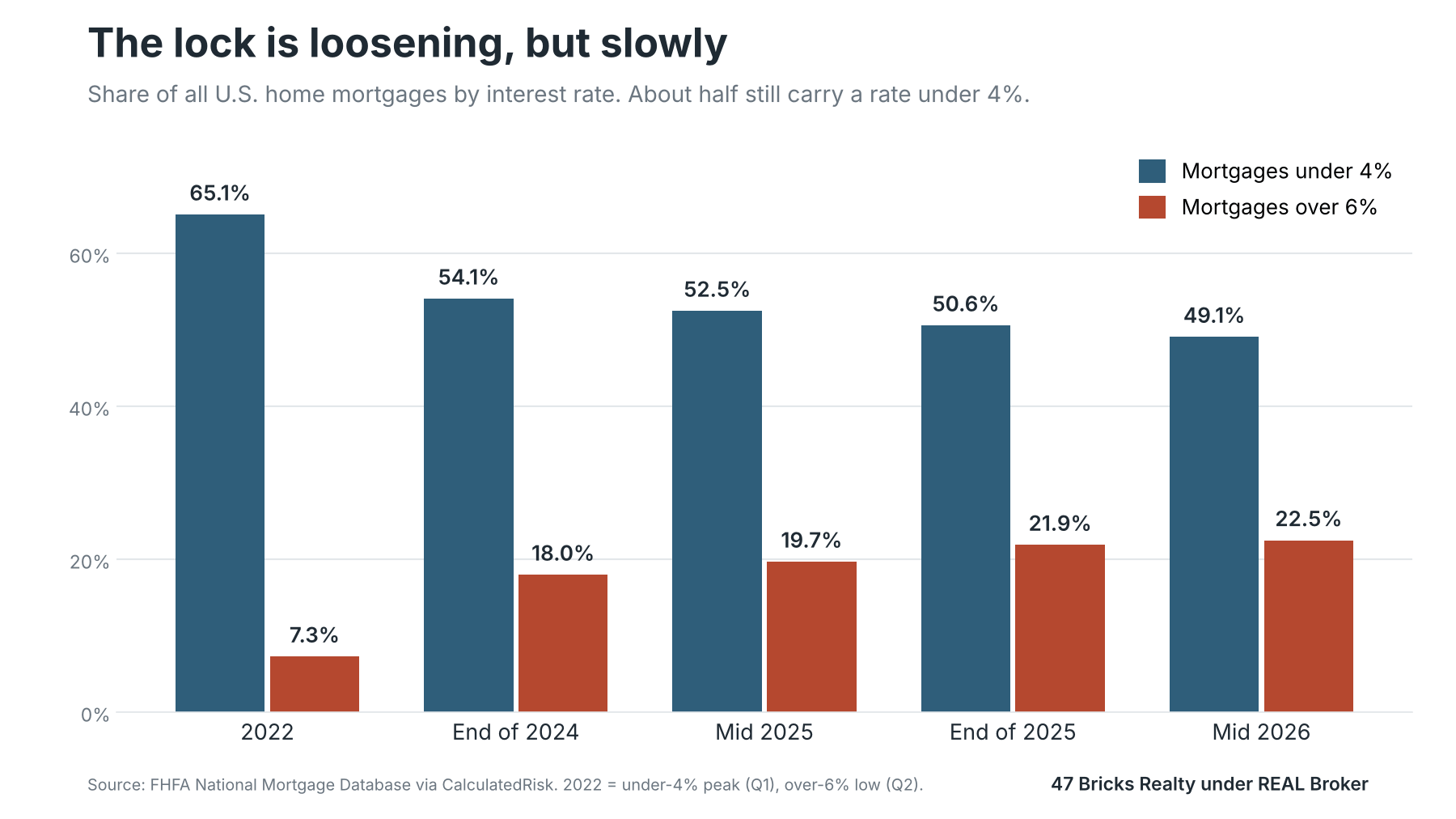
So the lock is loosening, but slowly. About half of homeowners with a mortgage still have a rate far below what they would pay on a new loan today.
Researchers at the Federal Housing Finance Agency (FHFA) measured how much this matters:
For every 1 percentage point that market rates sit above an owner's rate, the chance that owner sells drops by 18.1%.
Lock-in prevented about 1.33 million home sales from the second quarter of 2022 through the end of 2023.
Fewer homes for sale pushed prices up 5.7%. That was more than the 3.3% drop that higher rates would have caused on their own.
That last point is the surprise. Higher rates should cool prices by cutting what buyers can pay. Lock-in pushes the other way by cutting the number of homes for sale.
How it shows up in Dane County
The mortgage numbers above are national. I could not find the same rate data broken out for Dane County. But the local market looks exactly like a place where owners are holding on.
As of July 7, 2026, the Madison area had 773 single-family homes for sale without an accepted offer. That is about 1.8 months of supply, which is very tight.
In June 2026, 658 new single-family homes were listed, up 8% from 611 a year earlier.
Sales grew faster. June 2026 had 652 sales, up 20% from 544 a year earlier.
The median single-family price in June 2026 was $537,300, up 7% from $501,250 a year earlier.
So more homes are coming up for sale, but buyers snap them up. With so few owners willing to let go of their rate, the pool of homes stays small, and prices keep climbing.
We have had several buyers this year who have chosen to NOT sell their curren homes because of the low mortgage rates, and they have rented out their homes instead. This has the double negative impact of them buying a property, while also keeping their previous home.
What would have to happen for the lock to loosen?
I don't make predictions about rates or prices. But here is what would need to change for more locked-in owners to sell:
The rate gap shrinks. If market rates moved closer to what owners already have, the cost of moving would fall. The FHFA research shows every point of gap counts.
Time does its work. Each year, more low-rate loans end through sales, refinances, and payoffs. That is why the under-4% share keeps falling.
Life events win out. People still move for new jobs, bigger families, retirement, or an estate. Those moves happen no matter what rates do, and they add up over time.
For now, the rate gap has moved the wrong way for sellers. The average rate rose from 6.30% to 7.40% over the past year, which makes a low rate even harder to give up.
What this means for you
If you're buying: Don't plan around a sudden wave of listings. Supply is improving slowly. Have your financing ready so you can act when the right home shows up.
If you're selling: Fewer competing listings work in your favor. Price it right, though. Buyers still compare.
If you're locked in and thinking about moving: Run the full math. Compare your current payment with the new one, then weigh what the move gives you: more space, a better location, or cash from your equity. Sometimes the low rate is worth keeping. Sometimes the life change is worth more.
Have a question about your own situation? Call or text me at 608.213.3654.
Sources
Freddie Mac, Primary Mortgage Market Survey (week of October 8, 2026)
CalculatedRisk, FHFA's Q2 National Mortgage Database: Outstanding Mortgage Rates, LTV and Credit Scores (October 1, 2026)
CalculatedRisk, FHFA's Q1 National Mortgage Database: Outstanding Mortgage Rates, LTV and Credit Scores (July 1, 2026)
CalculatedRisk, FHFA's Q4 National Mortgage Database: Outstanding Mortgage Rates, LTV and Credit Scores (April 1, 2026)
CalculatedRisk, FHFA's Q3 National Mortgage Database: Outstanding Mortgage Rates, LTV and Credit Scores (December 30, 2025)
CalculatedRisk, FHFA's Q2 National Mortgage Database: Outstanding Mortgage Rates, LTV and Credit Scores (September 26, 2025)
CalculatedRisk, FHFA's National Mortgage Database: Outstanding Mortgage Rates, LTV and Credit Scores (March 31, 2025)
Federal Housing Finance Agency, Working Paper 24-03: The Lock-In Effect of Rising Mortgage Rates
Mad City Dream Homes, Madison area single family home trends for June, 2026