Why aren't Dane County home prices falling when fewer people are buying?
By Tony Hedberg, 47 Bricks Realty under REAL Broker
Short answer: Prices fall when there are more homes for sale than buyers. In Dane County, the number of buyers went down, but the number of sellers went down even more, so homes are still scarce and prices keep inching up.
Here is how that works, in plain terms.
Fewer buyers, but even fewer sellers
Across the country, home sales in 2025 fell to their lowest level since 1995. Higher mortgage rates priced a lot of buyers out, or made them wait.
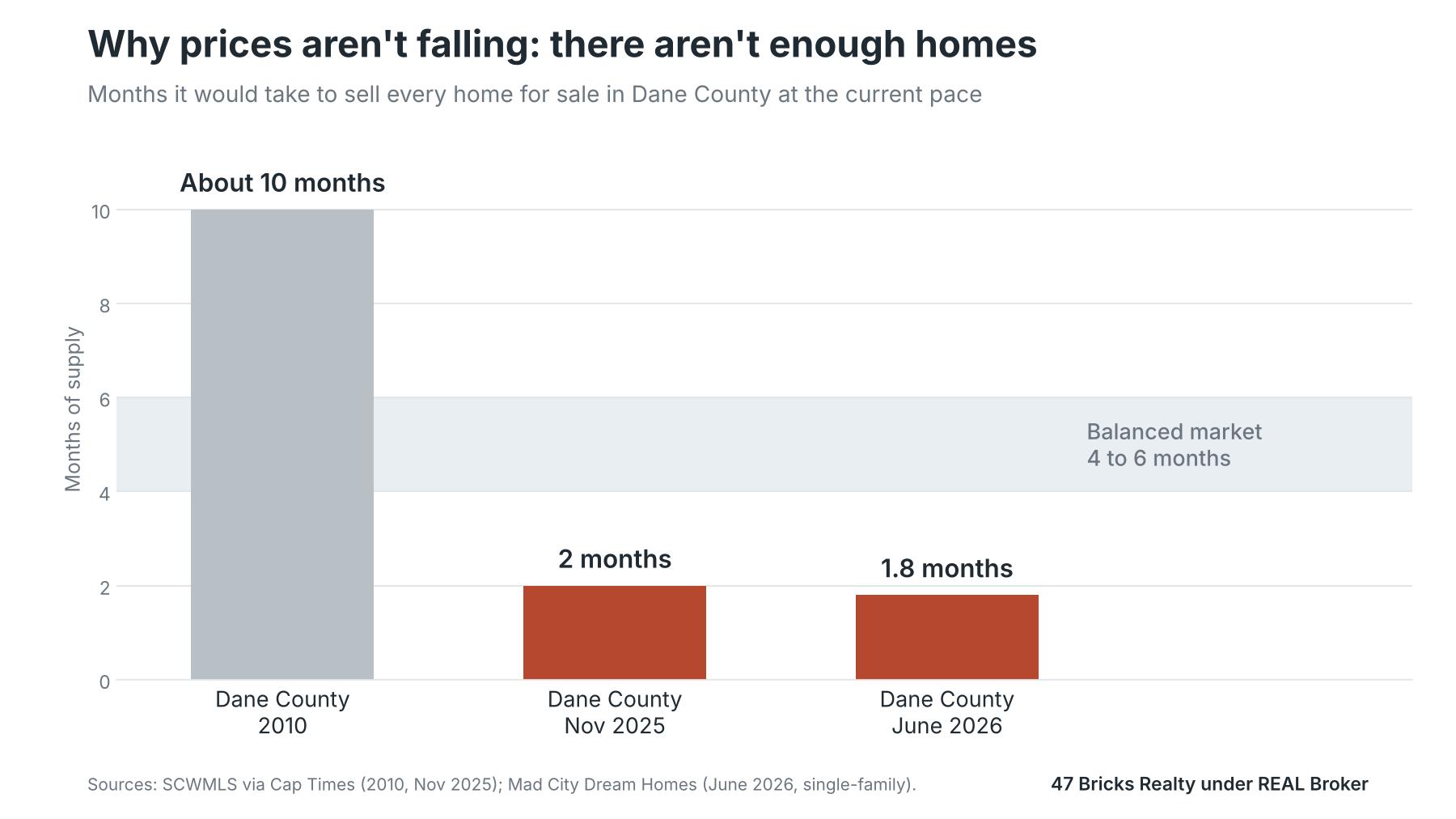
But price is not set by how many buyers there are. It is set by how many buyers there are compared to how many homes are for sale. That balance is measured in "months of supply," meaning how long it would take to sell every home on the market if no new listings came up.
A balanced market has about 4 to 6 months of supply.
In 2010, Dane County had roughly 10 months. Buyers had the upper hand, and prices were soft.
In June 2026, Dane County had about 1.8 months of single-family homes. That is still a seller's market.
So even with fewer buyers, there are still more buyers than homes.
Why sellers stopped selling: the lock-in effect
Millions of homeowners refinanced at 3% or less a few years ago. Selling would mean giving up that rate and taking a new loan at a much higher one, often for a similar house.
For many people, that math doesn't work. So they stay put. Economists call this the "lock-in effect." Every family that stays put is one less home for sale, and that keeps supply tight.
Dane County didn't build enough homes
This shortage started long before rates went up.
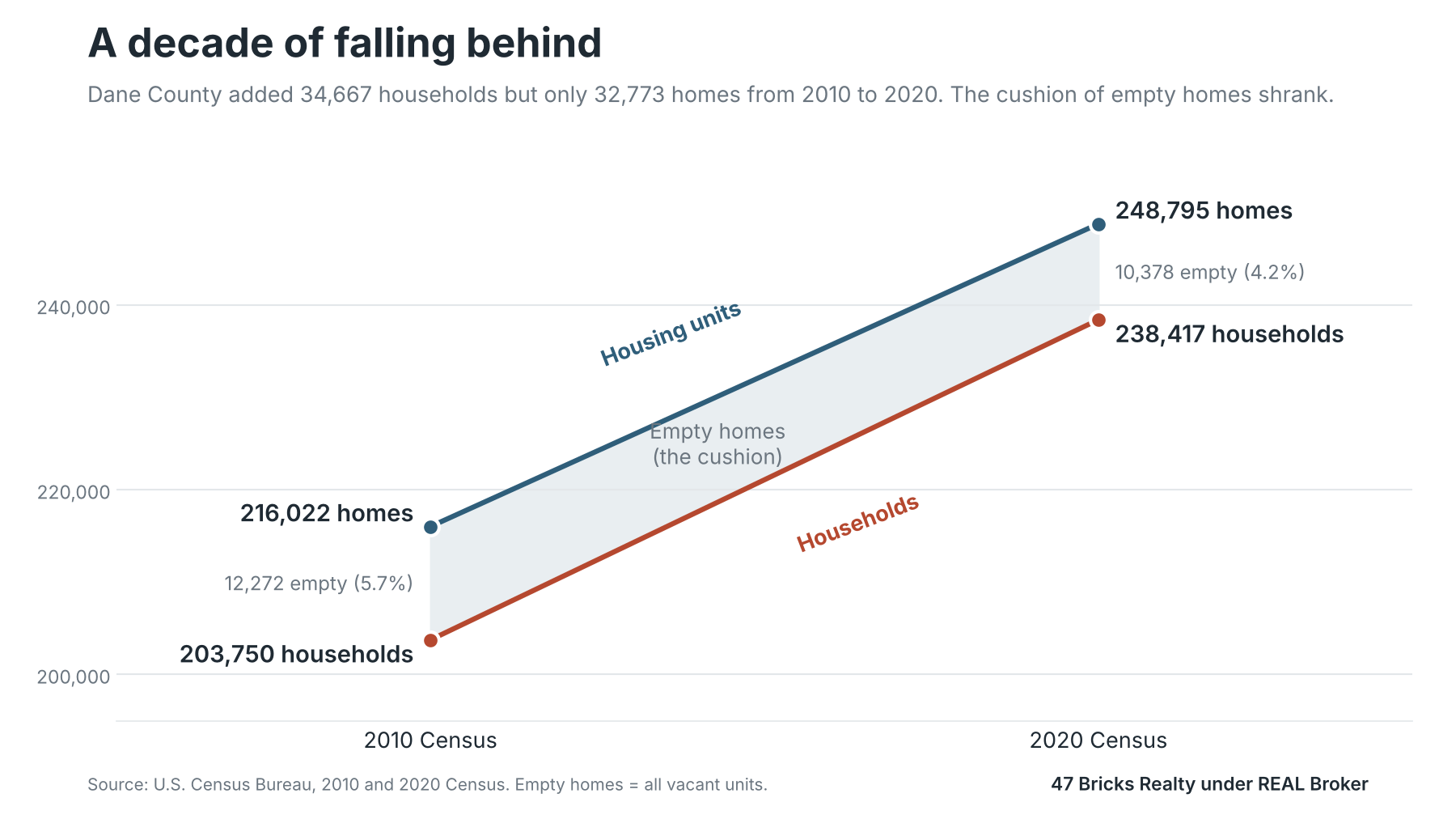
From 2010 to 2020, Dane County added about 34,700 households but only about 32,800 housing units, according to the U.S. Census.
Over that same decade, the share of empty homes fell from about 5.7% to about 4.2%. The cushion got thinner.
Dane County's own housing plan says the area builds about 5,000 units a year but needs about 7,000 a year to keep up.
Single-family construction is running at pre-COVID levels, and more than 50% below the pace of the early 2000s.
So what would make prices fall?
I don't make price predictions. But here is what would have to happen for Dane County prices to drop in a meaningful way:
A big jump in listings. For example, if rates fell and lots of locked-in owners decided to move at once.
A real hit to local jobs. Madison's economy leans on UW-Madison, state government, health care, and tech. That mix tends to hold up better than most in a downturn.
A long stretch of building more than we need. Dane County has not done that in well over a decade.
Without one of those, the more likely path is slower price growth, not falling prices.
The market is not the same for every home
Tight supply does not mean every home sells fast. Through June 2026, expired listings in Dane County were up 19% from a year earlier. Homes that are priced right still draw strong interest. In May 2026, about 37% of single-family contracts involved multiple offers. Homes that are overpriced, or need work, are sitting.
What this means for you
If you're buying: Waiting for a price drop is a gamble. A better plan is to get clear on your budget and be ready when the right home shows up.
If you're selling: You still have the advantage, but only if you price it right. Buyers are more careful than they were in 2021.
If you're on the fence: Look at the real cost of waiting a year: rent paid, equity not built, and where rates and prices are likely to be.
Have a question about your own situation? Call or text me at 608.213.3654.
Sources
U.S. Census Bureau, 2010 and 2020 Census (households and housing units, Dane County)
Cap Times, Dane County housing prices up again in 2025 (SCWMLS data, months of supply)
Mad City Dream Homes, Madison area single family home trends for June 2026
Mad City Dream Homes, Madison area home building update for March 2026
Dane County Regional Housing Strategy, Strategic Action Plan 2024 to 2028
Inman, 2025 existing-home sales (national sales lowest since 1995)