
Short answer: High prices usually pull more sellers into the market. In Madison, that pull is weak because most people who sell also have to buy, often at a much higher mortgage rate. At the same time, builders can't add homes fast enough to fill the gap.
Here is how that works, in plain terms.
High prices should bring out sellers. So why don't they?
In most markets, high prices act like a signal. When something sells for a lot, more people want to sell it. That extra supply helps cool prices.
Homes are different for one big reason: almost every seller still needs a place to live.
If you sell your Madison home for a high price, you will likely buy your next home at a high price too.
So a high price is not, by itself, a reason to move.
Economists would say the "supply response" to higher prices is small. In plain words: higher prices don't shake many homes loose.
The rate gap keeps owners in place
The other half of the math is the mortgage rate. For the week of October 8, 2026, the average 30-year fixed rate was 7.40%, according to Freddie Mac. A year earlier it was 6.30%.
Now compare that to the loans people already have. Federal housing finance data showed that at the end of 2025:
About half of all U.S. mortgages (50.6%) had a rate below 4%.
Only about 1 in 5 (21.9%) had a rate above 6%.
For an owner with a 3% loan, moving means trading a low payment for a much higher one, even for a similar house. That is the opportunity cost of selling. Many people look at that cost and decide to stay. We covered this "lock-in effect" in our last post, and it is a big part of the answer here too.
People are staying in their homes longer
Owners are also holding on longer than they used to. The National Association of REALTORS 2025 Profile of Home Buyers and Sellers found:
The typical seller was 64 years old, a record high.
The typical seller had lived in their home for 11 years, also a record.
Those are national numbers, but the pattern matters here. When the average owner moves less often, fewer homes come up for sale each year.
[TONY: add a quick example here of a homeowner who wanted to move but chose to stay, if you have one]
What the listing numbers show
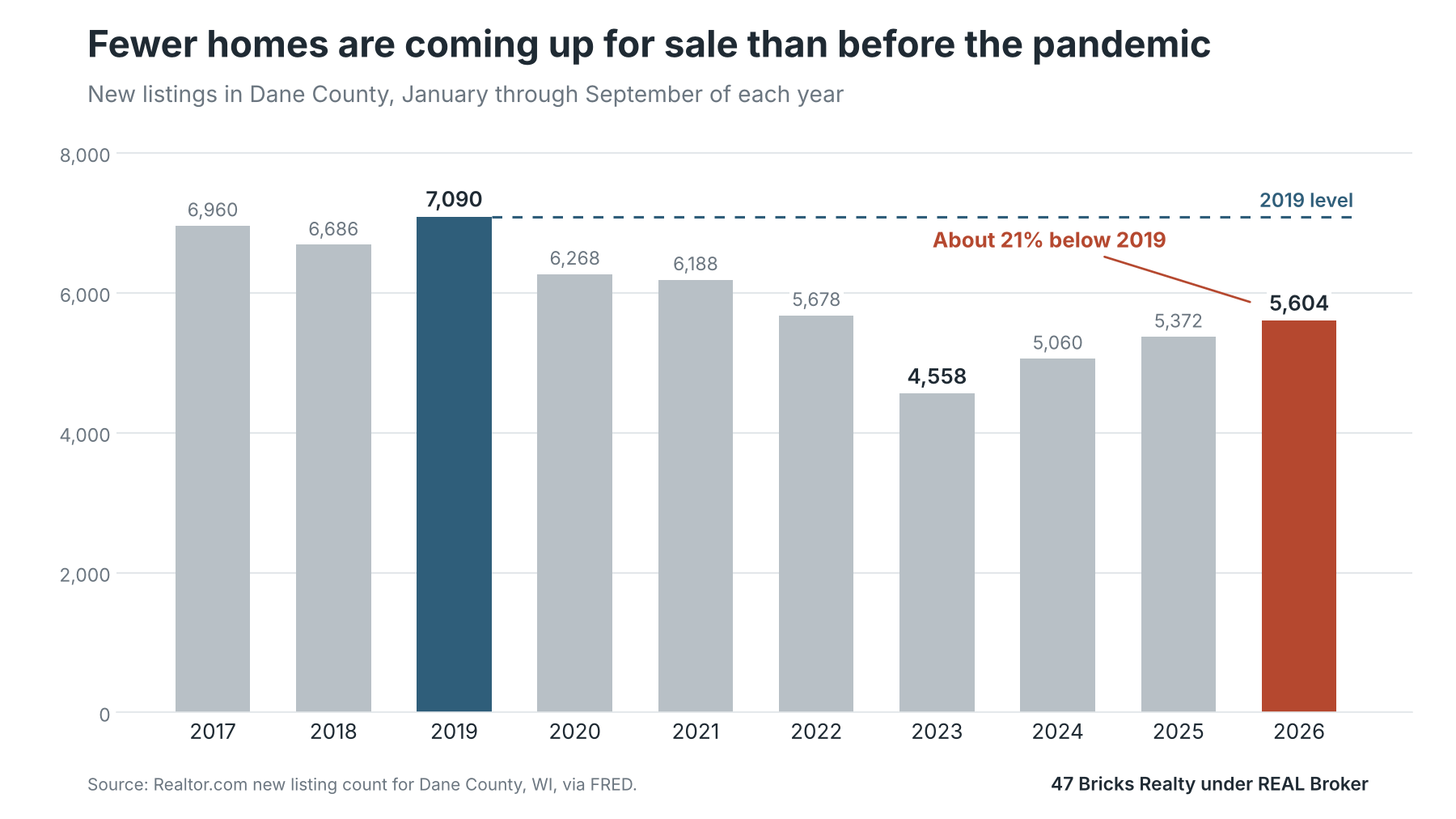
Dane County is getting more listings than it did two or three years ago. But it is still well short of where it was before the pandemic.
From January through September 2026, Realtor.com counted 5,604 new listings in Dane County.
Over the same months in 2019, it counted 7,090. That means 2026 is running about 21% lower.
The low point was 2023, with 4,558 new listings over those months.
The Madison area MLS tells a similar story. As of July 7, 2026, there were 773 single-family homes for sale without an accepted offer. That works out to about 1.8 months of supply, well under the six months the Wisconsin REALTORS Association uses as the mark of a balanced market. June 2026 brought 658 new single-family listings, up 8% from the year before and the highest June total in four years.
So supply is improving a little. It is just starting from a deep hole.
Why builders can't simply fill the gap
If existing owners won't sell, new construction is the other way to add homes. But building is slow, and it has not kept up.
Single-family construction in the Madison area is running at about pre-COVID levels, and more than 50% below the pace of the early 2000s.
Local planners expect Dane County to keep growing. A December 2025 projection from the Regional Data Group put the county at 887,000 people by 2050, up from 561,504 in the 2020 Census. The state's projection is lower, just under 778,000.
That same Regional Data Group projection points to a need for about 160,000 new housing units.
Land, labor, materials, and approvals all take time and money. Even when prices are high, a builder can't turn a field into a finished neighborhood in one season. So demand shows up fast, and supply shows up slowly.
What would have to happen for more homes to hit the market?
I don't make predictions. But here is what would need to change for Madison to see a lot more homes for sale:
The rate gap shrinks. If new mortgage rates moved closer to the rates owners already have, moving would cost less, and more owners might list.
Life events add up. Every year, people retire, downsize, relocate for work, or settle an estate. Over time, those moves happen no matter what rates do.
Building speeds up. A long stretch of building more homes than new households need would ease the shortage. Dane County has not had that in years.
Until one or more of those happens, a short supply of homes is the normal state of things here.
What this means for you
If you're buying: Don't wait for a flood of listings. Get your financing ready, know your must-haves, and be prepared to act when the right home shows up.
If you're selling: Low supply works in your favor, but buyers still compare. Homes that are priced right and show well get the strongest interest.
If you're thinking about moving up or down: Run the full math on both sides: what you'd sell for, what you'd pay next, and what the new payment would be at today's rates.
Have a question about your own situation? Call or text me at 608.213.3654.
Sources
Freddie Mac, Primary Mortgage Market Survey (week of October 8, 2026)
Calculated Risk, FHFA's Q4 National Mortgage Database (outstanding mortgage rates, Q4 2025)
HousingWire, First-time homebuyer share at record low, age at record high (NAR 2025 Profile of Home Buyers and Sellers)
Realtor.com, Housing Inventory: New Listing Count in Dane County, WI, via FRED, Federal Reserve Bank of St. Louis
Mad City Dream Homes, Madison area single family home trends for June, 2026
Mad City Dream Homes, Madison area home building update for March, 2026
Wisconsin REALTORS Association, Both Home Sales and Prices Increase at Midpoint of 2026
Cap Times, New Dane County population projections see growth accelerating