Short answer: Two things are true at once. Homes that are priced right and in good shape still sell, often for more than last year, so the median price keeps rising. Homes that are priced too high or need a lot of work are sitting until their listings run out, and there are more of those this year.
Here is how that works, in plain terms.
What an expired listing is
When you list a home, you sign an agreement with your agent for a set amount of time, often a few months. If the home does not sell before that time runs out, the listing "expires." The seller can relist, change the price, or take the home off the market.
So an expired listing is not a home that lost value. It is a home that did not find a buyer at the price and condition offered, in the time allowed.
The numbers: more expirations, higher prices
Here is what South Central Wisconsin MLS data shows for Madison area single-family homes this year:
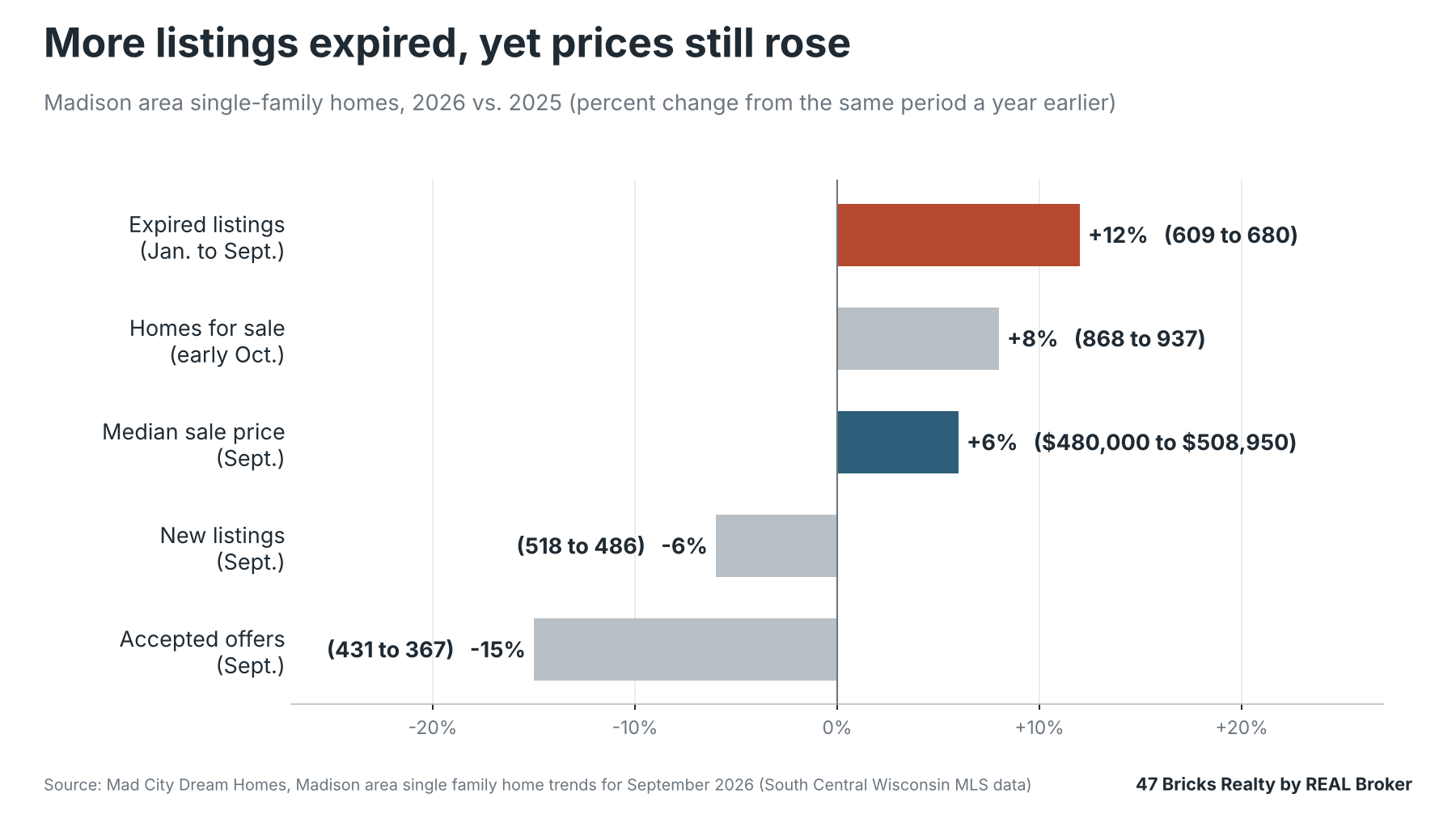
From January through September 2026, 680 listings expired without selling. That is up 12% from 609 a year earlier.
Expired listings are at their highest level since 2019.
Expirations rose earlier in the year too: up 28% through March and up 19% through June.
At the same time, the September median sale price was $508,950, up 6% from $480,000 a year earlier.
More homes failing to sell, and higher prices for the ones that do. That sounds like a contradiction. It is not.
Why both can happen: two markets in one
A median price only counts homes that actually sold. It does not count the homes that sat and expired. So the median tells you what buyers paid for the homes they chose, not what every seller hoped to get.
Think of it as two markets living side by side:
Homes priced right and ready to move into. These still draw strong interest. In September, homes that sold spent a typical 29 days on the market, down from 32 a year earlier. About 24% of August contracts involved multiple offers.
Homes priced too high or needing major work. These tend to sit, take price cuts, or expire. As one local market report put it, buyers won't write an offer on a home they see as overpriced or too costly to update.
Strong sales in the first group push the median up. Weak results in the second group push expirations up. Both numbers are honest. They just measure different homes.
Buyers have a little more room to say no
This is basic supply and demand. When buyers have more choices, they can be pickier.
As of early October, 937 single-family homes were for sale in the Madison area, up 8% from 868 a year earlier.
That works out to about 2.1 months of supply. A balanced market is usually about 4 to 6 months, so this is still a seller's market, just a less extreme one.
Accepted offers in September fell 15%, from 431 to 367.
A few years ago, almost any listing could find a buyer. Now a buyer can pass on a home that feels overpriced and wait for the next one. That extra breathing room is why more listings run out of time.
There is also an opportunity cost for buyers. Every dollar a buyer pays above a home's value, or spends on repairs, is a dollar they can't use somewhere else. With today's mortgage rates, that math feels heavier, so buyers focus on value.
Sellers are still pricing off the past
Many sellers set their price based on what a neighbor got in 2021 or 2022, when the market was hotter. Back in August 2021, 38% of contracts had multiple offers. In August 2026, it was 24%.
Some sellers would also rather wait than cut their price. Nationally, Realtor.com reported that 20.4% of listings had a price cut in August 2026. Earlier, in 2025, many sellers across the country pulled their homes off the market instead of taking a lower offer, and a record number of those homes came back on the market in January 2026, according to Redfin.
Here, the result is a gap between what some sellers ask and what buyers will pay. When that gap is too wide, the listing expires.
What would change this pattern?
I don't make price predictions. But here is what would have to happen for this mix to shift:
For expirations to fall: sellers would need to price closer to what recent sales support, or buyer demand would need to pick up, for example if mortgage rates came down.
For prices to fall: the number of homes for sale would need to climb much closer to a balanced 4 to 6 months of supply. At about 2.1 months, Dane County is not there.
What this means for you
If you're selling: Price for today's buyers, not for 2021. A home priced right from day one usually does better than one that chases the market down with cuts.
If you're buying: Rising expirations do not mean prices are falling. But a home that has sat for a while may leave room to negotiate.
If your listing expired: Look at price, condition, and how the home was shown. Those are usually the reasons, not the market.
Have a question about your own situation? Call or text me at 608.213.3654.
Sources
Mad City Dream Homes, Madison Area Single Family Home Trends for September, 2026 (South Central Wisconsin MLS data)
Mad City Dream Homes, Madison area single family home trends for June, 2026 (South Central Wisconsin MLS data)
Mad City Dream Homes, Madison area single family home trends for March, 2026 (South Central Wisconsin MLS data)
RISMedia, Delistings track down as pricing realism grows: report (September 2, 2026, Realtor.com August 2026 data)
Scotsman Guide, Delistings become relistings as home sellers recalibrate in 2026 (March 6, 2026, Redfin data)