
Short answer: Home prices are not set by the typical paycheck. They are set by how many buyers are competing for how few homes. Dane County has added jobs and households faster than it has added homes, so the buyers who can stretch the most set the price, and prices have pulled ahead of incomes.
Here is how that works, in plain terms.
Prices and paychecks moved together, until they didn't
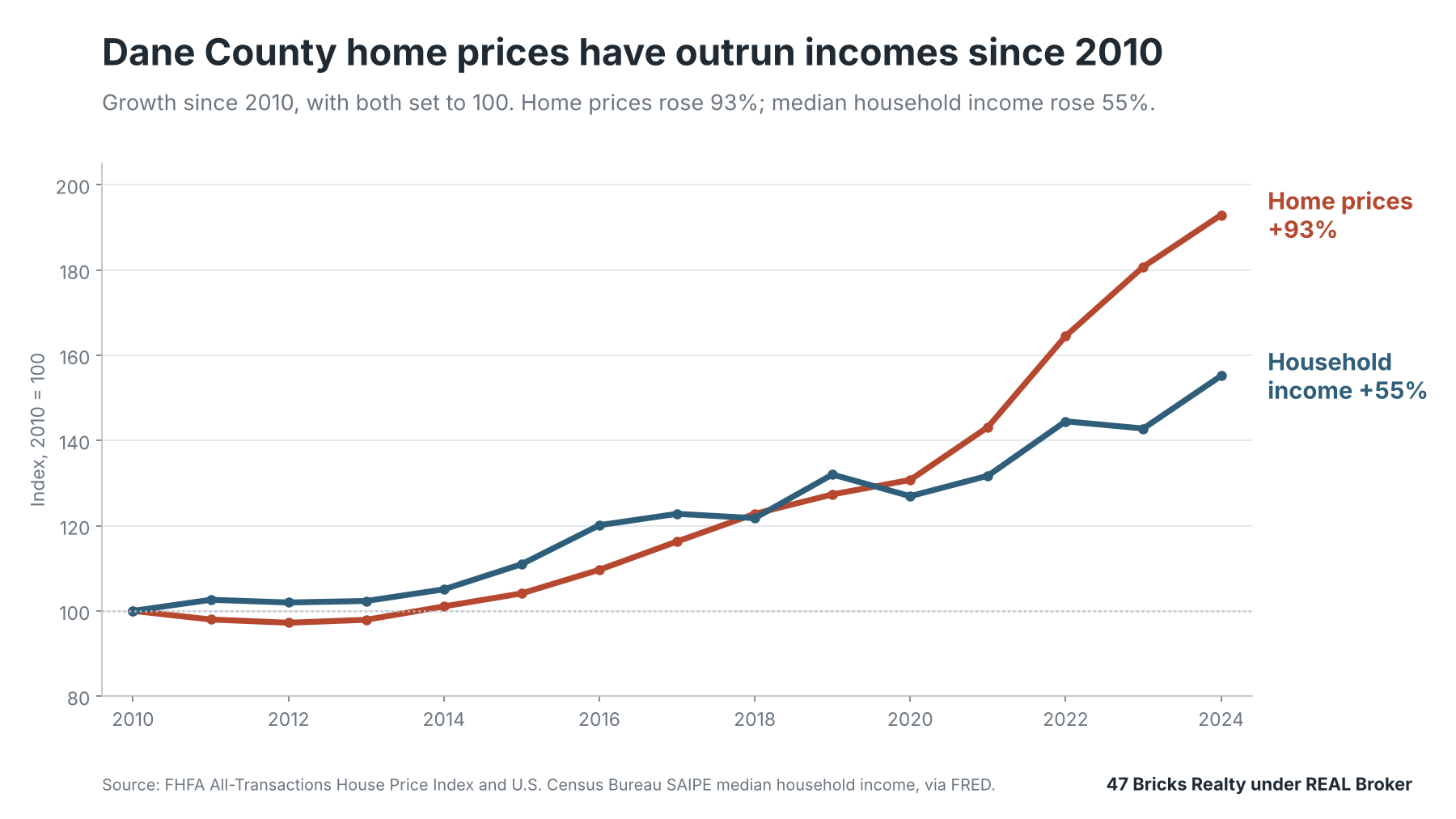
For most of the 2010s, Dane County home prices and incomes rose at about the same pace.
From 2010 to 2019, the median household income in Dane County grew about 32%, from $58,958 to $77,828.
Over the same years, home prices grew about 27%, based on the federal house price index for Dane County.
From 2019 to 2024, the story flipped. Home prices jumped about 52%. Median household income grew about 18%, to $91,479.
Put it all together, and from 2010 to 2024 home prices rose about 93% while household income rose about 55%.
Prices follow competition, not the average paycheck
A home is not priced like a gallon of milk. There is no set markup over cost. A home sells for what the most eager, best qualified buyer will pay for it.
So the question is not "what does a typical worker earn?" It is "how many buyers are chasing each home?" In Dane County, the answer has been: a lot.
Dane County added about 38,000 jobs from 2010 to 2020, about twice as many as Wisconsin overall, according to the county's housing plan.
Over that same decade, the county added about 8,000 more households than housing units.
The county builds about 5,000 units a year, but its plan says it needs about 7,000 a year to keep up.
When there are more buyers than homes, buyers bid against each other. The price gets set by the people who can stretch the furthest, not by the middle of the pay scale.
Cheap money pushed prices up fast
Most people buy a home with a loan. What really matters to a buyer is the monthly payment, not just the price.
When mortgage rates were very low in 2020 and 2021, the same monthly payment could support a much bigger loan. Buyers used that extra borrowing power to bid more for the same homes. That is a big reason prices jumped so much after 2020, even though paychecks did not.
When rates went back up, prices did not fall back, because the shortage of homes was still there. Buyers just had to stretch harder.
Many buyers are not paying with a paycheck alone
Income is only one part of what buyers bring to the table.
Equity from a home they already own. A move-up buyer who sells can put that gain toward the next home.
Two incomes. Household income counts everyone in the home, but many buyers have two earners working in good-paying local jobs.
Savings and family help. Some buyers bring cash that has nothing to do with this year's wages.
This is one reason prices can stay ahead of the typical paycheck. The people setting prices often have more than a paycheck to work with.
What it looks like today
Here is the gap in real dollars.
In 2010, the median home price in Dane County was about $226,000, according to the county's housing plan. That was about 3.8 times the median household income that year.
In the first 11 months of 2025, the median sale price was $452,000. That is about 4.9 times the 2024 median household income.
On October 8, 2026, Freddie Mac's average 30-year mortgage rate was 7.40%.
At that rate, a $452,000 home with 20% down has a principal and interest payment of about $2,500 a month. That is about a third of the median household's monthly income, before property taxes and insurance.
What would have to happen for paychecks to catch up?
I don't make price predictions. But here is what would have to happen for incomes to close the gap:
More homes, built steadily for years. If Dane County built closer to what its plan calls for, buyers would have more choices and less need to bid up prices.
Lower mortgage rates without a rush of new buyers. Lower rates help buyers, but they can also bring more buyers back to the market at once.
Incomes rising faster than prices for a long stretch. That happened for much of the 2010s, so it is possible. It took years, not months.
What this means for you
If you're buying: Budget by the monthly payment, not just the price. Include taxes and insurance, and know your number before you shop.
If you're selling: Your buyer pool is real, but buyers are stretched. Pricing right matters more than ever.
If you own and want to move up: Your equity is a real advantage. Look at what it can do for you before you decide.
Have a question about your own situation? Call or text me at 608.213.3654.
Sources
U.S. Federal Housing Finance Agency, All-Transactions House Price Index for Dane County, WI (via FRED, Federal Reserve Bank of St. Louis)
U.S. Census Bureau, Small Area Income and Poverty Estimates, Estimate of Median Household Income for Dane County, WI (via FRED)
Dane County Regional Housing Strategy, A Road Map to Solving Dane County's Housing Crisis: Strategic Action Plan 2024 to 2028
Cap Times, Dane County housing prices up again in 2025, listings show
Freddie Mac, Primary Mortgage Market Survey: Mortgage Rates Average 7.40% (October 8, 2026)